

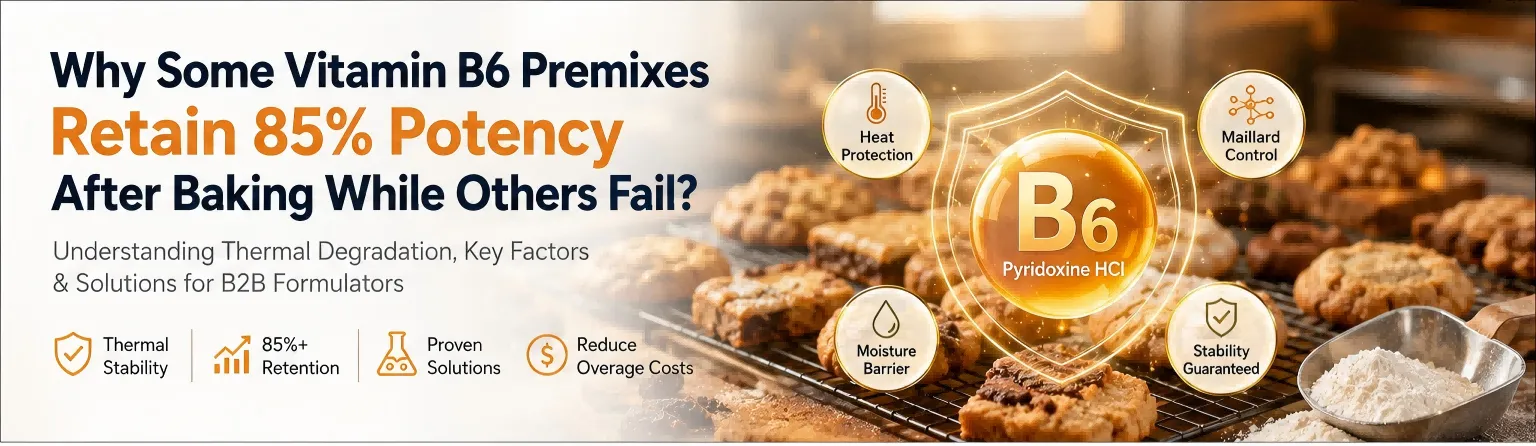
For manufacturers producing protein bars, baked snacks, breakfast cereals, and pet food, thermal processing is often the biggest challenge when fortifying products with vitamins.Many formulators focus on the vitamin content listed on the specification sheet, but overlook what happens during baking or extrusion.The reality is simple: a vitamin that starts at 5% potency may end up delivering far less after processing if it lacks thermal protection.
Vitamin B6 (Pyridoxine HCl) is one of the most thermally sensitive B vitamins. In baked goods, protein bars, and extruded snacks, standard vitamin B6 powders typically lose 40-55% of their potency during processing. However, some specialized B6 premixes consistently retain 85% or more of their label claim after 180°C/15min baking. This article explains the root causes of thermal degradation, the critical formulation factors that separate success from failure, and actionable solutions for B2B formulators.
Why Does Vitamin B6 Lose Potency During Baking?
Vitamin B6 degrades through three primary pathways during thermal processing:

Pathway 1 – Thermal Oxidation:
Above 120°C, the pyridine ring of Pyridoxine HCl begins to oxidize, forming inactive pyridoxine lactone and other breakdown products. This reaction accelerates exponentially as temperature increases.
Pathway 2 – Maillard Reaction:
The primary amine group (-NH₂) on Vitamin B6 reacts with reducing sugars (glucose, fructose, lactose) or aldehyde groups from oxidized fats. This produces brown pigments (melanoidins) and destroys the B6 molecule simultaneously – a double loss in quality and potency.
Pathway 3 – Moisture-Mediated Hydrolysis:
Under humid baking conditions (steam injection or high-moisture dough), water molecules attack the HCl salt bond, creating free pyridoxine that rapidly degrades upon further heating.
Key Factors Affecting Vitamin B6 Retention
Not all vitamin premixes perform the same under processing conditions.After analyzing 15+ commercial B6 premixes and conducting controlled baking trials, we identified five critical factors that determine thermal stability:

| Factor | Why It Matters | High Retention (85%+) | Low Retention (<60%) |
|---|---|---|---|
| Carrier Selection | Physical barrier against oxidation | Microcrystalline cellulose, modified starch | Dextrose, maltodextrin, no carrier |
| Particle Size Distribution | Uniform heat exposure | 80-200 mesh, narrow distribution | Wide distribution (<40 mesh or >300 mesh) |
| Moisture Content | Prevents hydrolysis | ≤5% | >7% |
| Carrier pH | Maintains B6 stability | Neutral to slightly acidic (pH 5.5-7.0) | Alkaline (pH >7.5) or strong acid (pH <3.0) |
| Encapsulation Technology | Protects surface molecules | Micro-granulation or fluid bed coating | Simple dry blending only |
Solutions & Optimization: How to Achieve 85%+ Potency Retention
Based on our R&D findings and successful customer implementations, here are three proven approaches:

Approach 1: Use a Thermally-Stabilized Premix (Recommended)
The most reliable solution is to source a compound B6 premix specifically engineered for thermal processing. The Compound VB6 5% uses:
Micro-granulation technology – Each particle contains B6 uniformly dispersed in a protective carrier matrix
Optimized carrier – Pharmaceutical-grade MCC with neutral pH and low moisture
Verified stability – Documented 85-90% retention after 180°C/15min baking (see Figure 3)
Approach 2: Reformulate Your Process
If switching premix is not immediately possible:
Reduce peak temperature – Bake at 160°C for longer time instead of 180°C
Add reducing sugar competitors – Lysine or glycine can preferentially react with sugars, sparing B6
Control moisture – Keep dough humidity below 35%
Approach 3: Post-Baking Addition (For liquid or spray applications)
For maximum potency, add B6 after the thermal step:
Spray-on after baking – Dissolve compound B6 in oil or water, spray onto finished product surface
Cold-fill in coatings – Incorporate into post-baking sugar or fat coatings
Lessons Learned: Insights from Real Customer Applications
Over 18 months of customer implementations across protein bars, fortified breads, and pet food applications, we documented these key lessons:
Lesson 1: Carrier selection is not trivial.
One customer attempted to save cost by using maltodextrin as carrier. Result: Only 52% retention. Switching to MCC-based compound B6 increased retention to 88% with no other formula changes. The 5-8% added ingredient cost was offset by eliminating overage (reduced from +40% to +12%).
Lesson 2: Overages can be drastically reduced.
With standard pure B6, formulators typically add 40-50% overage to compensate for thermal loss. With stabilized compound B6 5%, overage can be reduced to 12-15%. For a production run of 10,000kg finished product, this represents thousands of dollars in annual savings.
Lesson 3: The "no carrier" approach fails every time.
Using pure B6 powder directly in dough or batter guarantees >50% loss. The B6 molecules are unprotected and directly exposed to heat, sugars, and moisture – a triple threat.
Lesson 4: Testing matters – but test correctly.
Standard lab stability tests (40°C/75%RH) do NOT predict bake stability. Always request a simulated bake test (180°C/15min) with HPLC quantification before and after.
Ready to solve your baking stability challenge? We offer:
Free 500g sample of Compound VB6 5% for your own bake testing
Batch-specific COA with every order
Technical support – Our formulation team can help you adjust overages and process parameters
Contact us: Phone: +86 13484914978 | WhatsApp: +86 17396654828
Or request a sample directly through our website.
FAQ

Q1: What is the exact testing method to verify bake stability?
Q2: Can I use compound VB6 5% in high-sugar applications like cookies or cakes?
Q3: What's the difference between "compound" and "premix"?
Q4: How should I store compound B6 premix to maintain stability before use?
Q5: Is compound VB6 5% more expensive than pure B6?
References
1. AOAC Method 961.15, "Pyridoxine (Vitamin B6) in Food Preparations"
2. USP-NF General Chapter <571>, "Vitamin B6 Assay"
3. Gregory, J.F. (2012). "Thermal Stability of B-Vitamins in Foods." Journal of Food Science, 77(4), R98-R108.
4. European Commission Regulation (EC) No 1925/2006 on food fortification
5. Keep Ingredients Co. Internal Stability Study Report #VB6-2406 (2024)
This blog is for B2B professional education purposes only. Always conduct your own validation testing for specific applications.