

If you search for Choline Chloride suppliers online, you may quickly notice a surprising fact:
Products carrying the same name can vary dramatically in price.
In many cases, the difference is not the choline content itself-it is the intended application and quality standard behind the ingredient.
For procurement teams sourcing ingredients for dietary supplements, functional foods, infant nutrition, or pharmaceutical formulations, one of the most common and costly mistakes is assuming that all Choline Chloride products are interchangeable.
They are not.
The critical distinction lies between USP-grade Choline Chloride and feed-grade Choline Chloride.
Why Do You Need to Distinguish Between USP‑Grade and Feed‑Grade Choline Chloride?
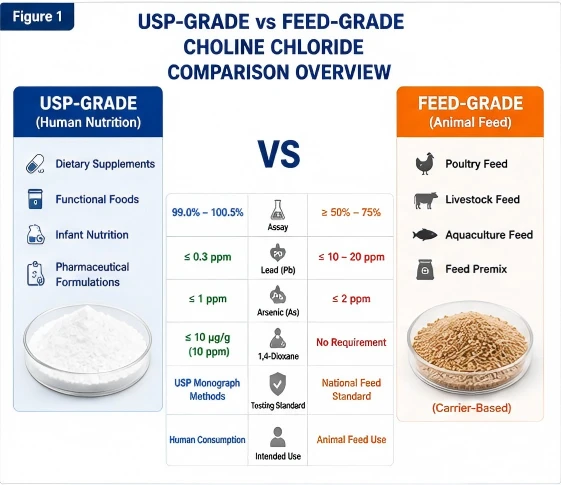
📌 Key facts at a glance: USP‑grade choline chloride requires an assay of ≥99.0% and ≤100.5%, with strict limits on 1,4‑dioxane, total amines, and heavy metals. Feed‑grade choline chloride is usually carried on corn cob or rice hull, with a typical concentration of ≥50% or ≥60% and looser impurity specifications.
The two main application scenarios – animal feed (feed‑grade) and human dietary supplements / functional foods (USP‑grade) – determine the fundamental differences between the two specifications.
Animal feed: Choline chloride is used as a feed additive to support growth and metabolism in poultry and livestock. It is usually added to premixes at relatively low concentrations.
Human nutrition: As a GRAS (Generally Recognized as Safe) nutrient, choline chloride is widely used in tablets, capsules, gummies, functional beverages, and other products. It is listed in the FDA's GRAS regulations (21 CFR 182.8252). In late 2023, the U.S. National Institutes of Health (NIH) set the adequate daily intake for choline at 550 mg for adult men and 425 mg for adult women – clear evidence that choline chloride, as a nutritional ingredient, is experiencing sustained demand growth in the human nutrition market.
One issue often overlooked by buyers: feed‑grade and USP‑grade choline chloride can originate from the exact same synthesis line. The difference often lies only in the depth of purification and the stringency of impurity testing. If a supplier repackages feed‑grade material as "USP‑grade", it is extremely difficult for a buyer to detect the problem by sensory or basic physical tests alone.
That is why critical acceptance criteria must be locked into the contract from the very beginning.
Key Differences Between USP‑Grade and Feed‑Grade Choline Chloride
1. Purity / Assay: Not "Higher is Better", but "Exactly Compliant"
This is the most obvious difference:
USP‑grade: Assay must be between 99.0% and 100.5% (calculated on the anhydrous basis).
Feed‑grade: Usually carried on a carrier (e.g., corn cob powder, rice hull powder), with labeled assay typically ≥60%, ≥70%, or ≥75% (diluted by the carrier); some high‑purity powder forms may have lower labeled values such as ≥50%.
FCC food‑grade: Falls in between, requiring ≥98.0% and ≤100.5%.
📊 Critical nuance: USP‑grade has an upper limit (≤100.5%) , not just a lower limit. This upper limit prevents over‑addition and helps detect adulteration – some adulterated materials can show falsely high assay values. Whether your contract includes an upper limit is an important signal of the supplier's quality mindset.
2. Heavy Metal Limits: Largest Gaps in Arsenic and Lead

The differences in heavy metal limits between grades are significant:
| Parameter | USP‑Grade (reference) | Feed‑Grade (reference) | Unit |
|---|---|---|---|
| Arsenic (As) | ≤1 ppm | ≤2 mg/kg | ppm / mg/kg |
| Lead (Pb) | ≤0.3 ppm | ≤10–20 mg/kg | ppm / mg/kg |
| Heavy metals (total) | ≤10 ppm | ≤20 mg/kg | ppm / mg/kg |
| Cadmium (Cd) | ≤1 ppm | not specified | ppm / mg/kg |
Feed‑grade allows Pb up to 20 mg/kg – roughly 65 times higher than USP‑grade (≤0.3 ppm). This single difference determines whether your product can pass human food safety audits.
 3 .Organic Impurities: The Hidden Red Line – 1,4‑Dioxane
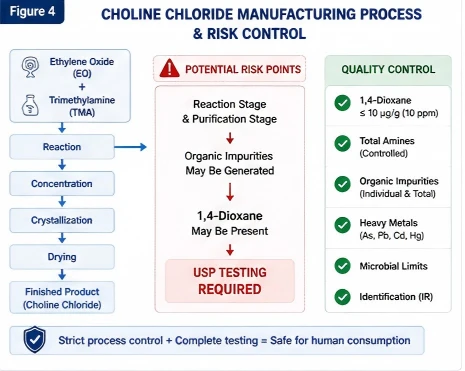
During choline chloride production, poor process control can generate trace organic impurities, most notably 1,4‑dioxane – classified by IARC as a Group 2B carcinogen (possibly carcinogenic to humans). Therefore, its presence is tightly restricted in food applications.
USP‑grade: 1,4‑dioxane limit ≤10 μg/g (i.e., 10 ppm), and it is a mandatory test item under organic volatile impurities.
Feed‑grade: The Chinese national standard GB/T does not explicitly set a limit for 1,4‑dioxane in feed‑grade choline chloride.
FCC food‑grade: Only requires "passes test" without specifying a numerical limit.
📌 Supplier observation: Analyses of multiple USP‑grade batches show that for compliant material, actual 1,4‑dioxane levels are typically controlled below 10 μg/g.
The main production route for choline chloride is: ethylene oxide + trimethylamine → reaction → concentration → crystallization → drying. If the supplier's purification steps (such as rectification or deep crystallization) are incomplete, byproducts like 1,4‑dioxane can remain. That is why your contract must explicitly require testing for 1,4‑dioxane by USP methods, with documented results. Total amines are another impurity to control – excess amines cause off‑odors, off‑tastes, and stability issues.
4 .Testing Methods and Regulatory Systems: USP vs. Feed‑Grade National Standards
USP‑grade logic: The USP monograph requires that choline chloride be tested by officially recognized laboratories (or qualified in‑house labs) using the specific methods prescribed in USP (e.g., IR identification, microbial limits, organic volatile impurities). The key is that the methods must be traceable to the pharmacopoeial standard. In other words, "USP grade" is not just a concentration claim – it is a system of measurement and judgment.
Feed‑grade logic: The Chinese national standard GB 7300.206‑2025 (effective January 1, 2027) mainly covers raw material specifications, technical requirements, and inspection rules for feed additives. It focuses on purity, moisture, and heavy metals, but does not cover organic impurities with the same rigor.
USP‑EP mutual recognition background: EP 9.0 / BP 15 requirements are generally aligned with USP, but they place additional emphasis on individual impurity limits and total impurity limits – another area where systematic differences can occur between grades.
Solution & Optimization: Managing USP Choline Chloride in Production
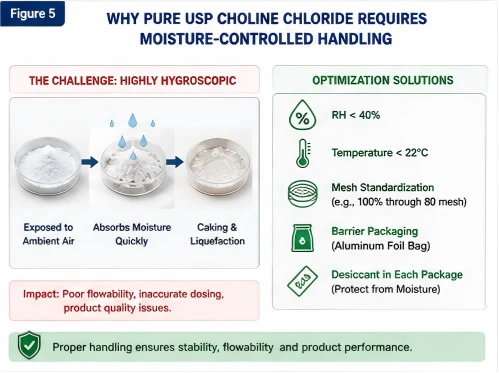
If your product formula targets humans (infant formula, nootropics) or premium clinical veterinary diets, you must use USP-Grade Pure Powder. However, moving from a carrier-bound feed grade to a pure 99% USP crystalline powder introduces a major physical headache: extreme hygroscopicity.Pure Choline Chloride is deliquescent; it absorbs ambient moisture so aggressively that it liquefies within minutes of exposure to air.
Technical Optimization Solutions:
Climate-Controlled Processing:
Ensure your blending and packaging cleanrooms maintain a Relative Humidity (RH) below 40% and temperatures below 22°C.
Strategic Particle Sizing:
Source USP Choline Chloride that has been mesh-standardized (e.g., 100% through 80 mesh) to ensure predictable flowability during high-speed capsule filling or tableting.
Barrier Packaging:
Ensure your supplier packs the material in heat-sealed, multi-layer aluminum foil bags with dedicated desiccants inside a rigid fiber drum.
A Practical Six‑Step Checklist for Sourcing USP‑Grade Choline Chloride
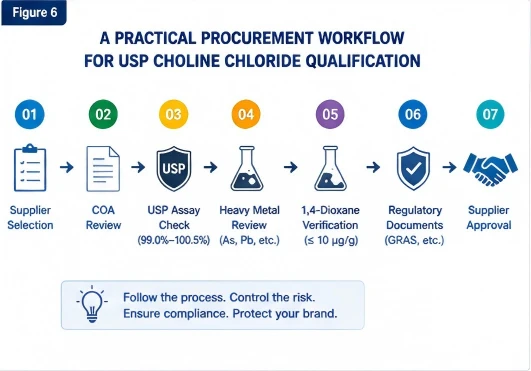
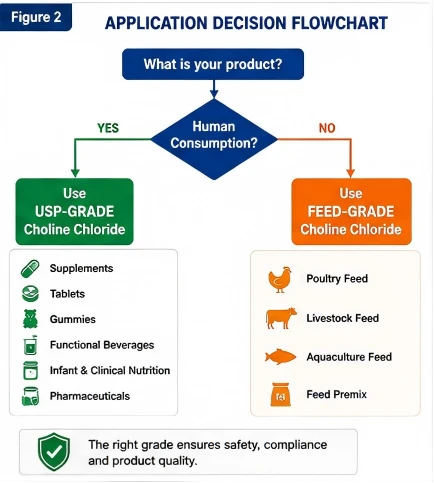
Step 1: Define the application and target use
Ask first: What will you use the choline chloride for?
Human dietary supplements / functional foods → Must be USP‑grade
Animal feed → Feed‑grade is sufficient
Pharmaceutical excipient → Must be USP‑grade plus additional GMP requirements
Step 2: Request a complete COA before each shipment
The COA must include these five key data points:
Assay: 99.0%–100.5%
Arsenic (As): ≤1 ppm
Lead (Pb): ≤0.3 ppm
1,4‑Dioxane: ≤10 μg/g
Organic impurities: individual ≤0.3%, total ≤2.0%
Step 3: Confirm the testing methods used
The COA must explicitly state "tested by current USP‑NF monograph methods" – not internal rapid methods.
Step 4: Request regulatory compliance documents
If your finished product will enter the U.S. market, ask for documentation showing compliance with 21 CFR 182.8252 (human food GRAS) or 21 CFR 582.5252 (animal feed GRAS).
Step 5: Conduct an on‑site or document audit
Request copies of the supplier's ISO22000, BRC, HACCP, and other certifications. Verify that their quality management system has been effectively operating for at least one year.
Step 6: Reserve the right to retain and test samples
Add a clause: "Buyer has the right to retain samples from each delivered batch and to send those samples to a mutually agreed third‑party laboratory for retesting. If non‑compliance is found, the cost of retesting shall be borne by the supplier."
Market Experience: Real Feedback from Procurement Managers
After speaking with multiple dietary supplement contract manufacturers and feed mill purchasing managers, several practical observations stand out:
Experience 1 – Packaging can be misleading: Some feed‑grade choline chloride is packaged as a white crystalline powder similar to USP‑grade material, but the internal quality standard remains feed‑grade. Some purchasing managers judge "meets USP requirements" by appearance alone – a judgment that will not hold up to lab verification.
Experience 2 – Cost logic: It is not economical to buy USP‑grade for feed applications. Feed‑grade is less expensive partly because it can be used with a carrier – that carrier is part of the feed formulation design, not just a sign of loose impurity control. So a higher price does not automatically mean "higher grade" for your use case; you must match the grade to your actual application (feed vs. human nutrition/pharma).
Experience 3 – Cross‑border contract traps: Suppliers from different countries may label their product as "FCC food‑grade" instead of USP‑grade, or use non‑pharmacopoeial methods (which differ in sensitivity from pharmacopoeial methods like UV‑Vis colorimetry, rapid chromatography, etc.).
Your contract should explicitly state: "The product shall fully comply with all requirements of the current USP‑NF monograph for Choline Chloride, and the buyer retains the right to re‑test any batch using USP‑published methods."
FAQ

Q1:Can feed-grade choline chloride be used after simple purification for supplements?
Q2: Is USP-grade choline chloride more hygroscopic than feed-grade?
Q3. Is assay value the most important specification?
Q4: Does USP‑grade choline chloride have a shelf life? How should it be stored?
Q5:How can I easily tell if a sample is Feed-Grade or USP-Grade without a lab test?
A:Feed-grade typically has a distinct tan, brown, or off-white color and smells intensely of toasted grain or faint fish due to the corn cob carrier and higher residual amines.
USP-grade is a stark, bright white crystalline powder with a nearly neutral to very mild amine odor.
References
United States Pharmacopeia (USP). Monograph on Choline Chloride. USP-NF.
USP-NF (United States Pharmacopeia–National Formulary). Choline Chloride Monograph. USP-NF Online. (Accessed 2026-06-01).
European Food Safety Authority (EFSA). Safety and efficacy of choline chloride as a feed additive.
FDA (2024). CFR – Code of Federal Regulations Title 21. 21 CFR 182.8252 Choline chloride. U.S. Food and Drug Administration.
Food and Drug Administration (FDA). CFR Title 21 - Food and Drugs: Substances Generally Recognized as Safe (GRAS).
National Center for Biotechnology Information. PubChem Compound Summary for Choline Chloride (CID 6209).
GB 7300.206-2025. Feed additive – Part 2: Vitamins and similar substances – Choline chloride. State Administration for Market Regulation & Standardization Administration of China. Issued 2025-12-31, effective 2027-01-01.
Glentham Life Sciences (2024). Choline chloride, USP grade – Product Specification.
MP Biomedicals (2023). Certificate of Analysis – Choline Chloride.
AMMOL (2024). Choline Chloride USP Dietary Supplement Specifications.
FDA SCOGS Report No. 42. Evaluation of the Health Aspects of Choline Chloride and Choline Bitartrate as Food Ingredients.
NB Group (2019). Choline Chloride – FCC Grade Specification.