

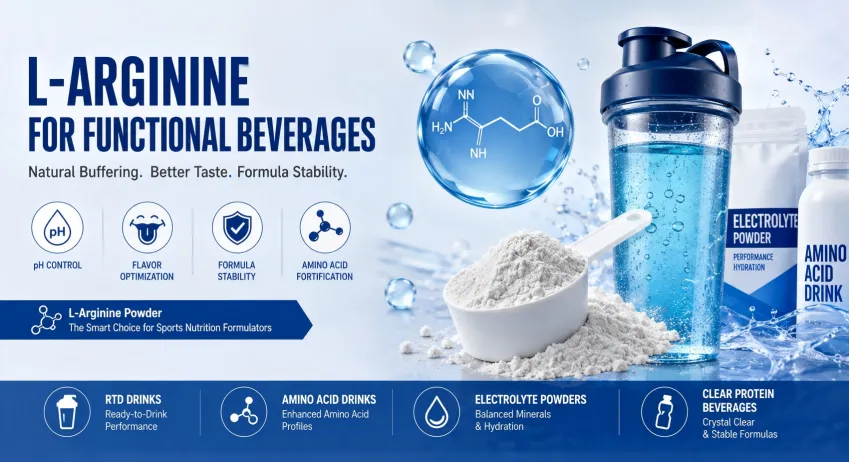
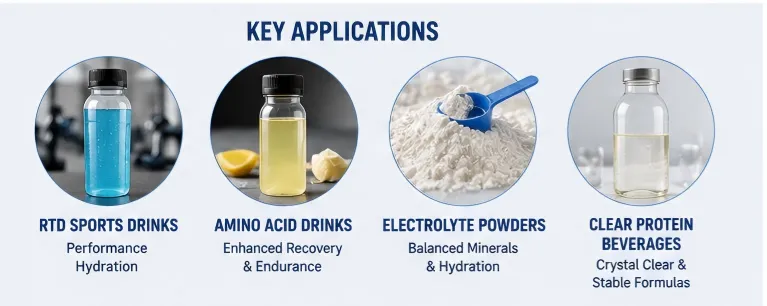
Modern active consumers are no longer satisfied with simple sugar-and-electrolyte waters; they demand advanced products like Ready-to-Drink (RTD) pre-workout shots, high-performance amino acid drinks, intra-workout electrolyte powders, and clear protein beverages.
For brands, this shift means amino acid fortification has transitioned from a niche marketing trend into a baseline manufacturing requirement.
When developing a functional beverage – whether an RTD sports drink, an amino acid shot, or an electrolyte powder – formulators face a common challenge: maintaining a stable pH without sacrificing taste.
Traditional buffering agents such as sodium bicarbonate or potassium citrate often introduce unwanted saltiness, metallic aftertaste, or excessive sodium. This is where L‑Arginine Powder offers a unique, multifunctional solution. As a naturally occurring basic amino acid, L‑Arginine acts not only as a buffering agent but also as a valuable nutritional component. In this article, we will explore why more and more sports nutrition formulators are turning to L‑Arginine for pH control, flavor optimization, and long‑term stability in modern functional beverages.
The pH Challenge in Functional Beverages
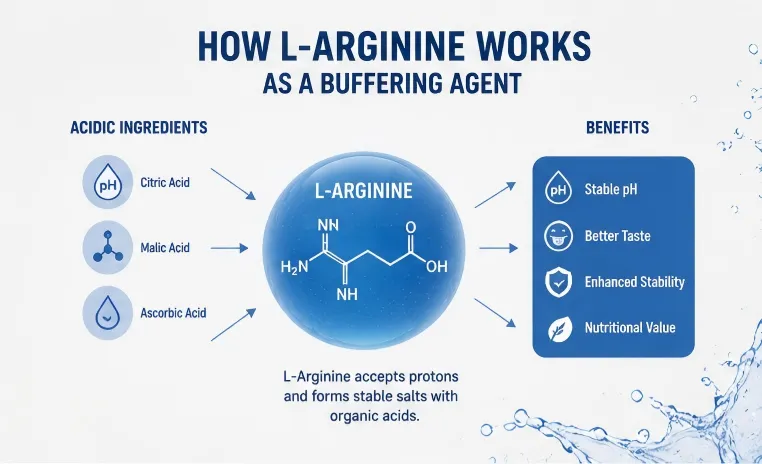
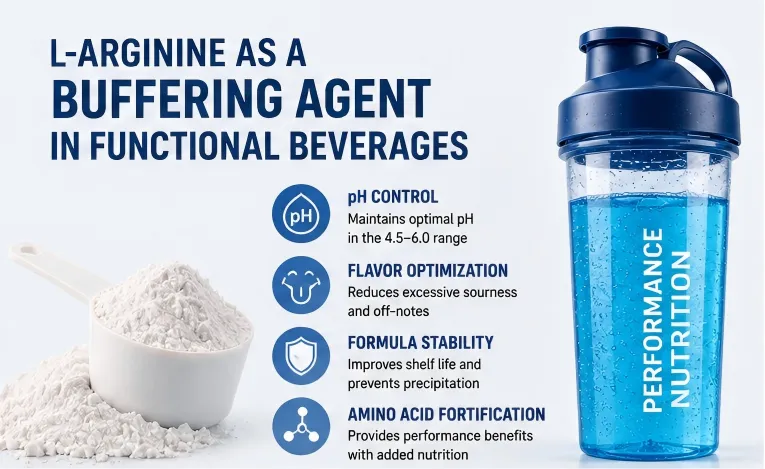
Functional beverages often contain acidic ingredients – citric acid, malic acid, ascorbic acid, or even certain amino acids – to achieve a refreshing taste or preserve the product. However, a pH that is too low (below 4.0) can cause excessive sourness, irritate the oral mucosa, and accelerate the degradation of sensitive nutrients like B‑vitamins or some artificial sweeteners. On the other hand, a pH that is too high (above 6.5) may promote microbial growth or cause precipitation of minerals. The goal is to keep the final pH in a comfortable range of 4.5–6.0, which requires a reliable buffering system.
Limitations of Conventional Buffering Agents
Sodium bicarbonate (baking soda) is effective but leaves a distinct salty and slightly bitter taste; it also generates carbon dioxide bubbles, which can be undesirable in still beverages.
Potassium citrate is more neutral, yet it contributes a significant amount of potassium and may affect flavor clarity.
Sodium hydroxide or potassium hydroxide are too aggressive and do not provide any nutritional benefit. Formulators need a buffering agent that is gentle, clean‑tasting, and ideally adds functional value.
Why L‑Arginine Powder Is the Ideal Buffering Agent
L‑Arginine is a basic amino acid with a pKa of approximately 12.5. When added to an acidic beverage, its guanidino group readily accepts protons, forming L‑Arginine salts with organic acids such as citrate, malate, or lactate.
This reaction gently raises the pH while creating a buffering system that resists further pH drops. Unlike inorganic alkalis, L‑Arginine does not produce a "chemical" taste.
Instead, the formed arginine‑organic acid salts are known for a smoother, rounder mouthfeel with no lingering bitterness or saltiness.
pH Control Without Compromising Flavor
One of the biggest advantages of using L‑Arginine Powder in beverage formulation is its ability to replace traditional buffering salts without introducing off‑notes. In blind taste tests, functional beverages buffered with L‑Arginine are consistently described as having a "clean finish" and "natural acidity." This makes it particularly suitable for premium sports nutrition products where flavor profile is a key differentiator.
Synergy with Amino Acid Fortification
Many functional beverages are already fortified with branched‑chain amino acids (BCAAs), glutamine, or citrulline. Adding L‑Arginine not only serves as a buffering agent but also contributes to amino acid fortification. L‑Arginine is a precursor of nitric oxide, which supports blood flow, endurance, and muscle pump – a highly desired benefit in sports nutrition. By using L‑Arginine as a buffer, formulators can reduce or eliminate other pH adjusters while simultaneously increasing the total amino acid content and functional claim potential.
Formula Stability: Preventing Sedimentation in Complex Beverage Matrices
For R&D teams formulating advanced electrolyte powders or clear protein beverages, maintaining permanent visual clarity and preventing sedimentation are critical quality benchmarks.
Clear Protein Beverages
Clear whey protein isolates (WPI) and plant-based clear proteins are highly sensitive to rapid pH shifts. If a production team utilizes an inorganic strong alkali to adjust pH, the local environment can cross the protein's native isoelectric point (pI). This leads to instantaneous denaturing, cloudiness, and white sediment formation. Because L-Arginine Powder buffers smoothly, it prevents localized protein aggregation. This guarantees a crystal-clear appearance throughout the product's shelf life.
Electrolyte Powders
In dry-blend electrolyte powders, moisture control is crucial. Free organic acids are highly hygroscopic, meaning they pull water vapor from the air, causing the powder mixture to cake, harden, and lose its free-flowing properties. When high-purity L-Arginine is co-formulated into the mix, it behaves as a stabilizer, balancing the chemical activity of moisture-sensitive ingredients and preserving mixability for consumers.
The Clean Label Advantage: Maximizing Cost-Efficiency via Dual-Functionality
| Parameter / Benefit | Traditional Inorganic Buffers (e.g., NaOH, Sodium Bicarbonate) | Pure L-Arginine Powder Buffer |
|---|---|---|
| Primary Mechanism | Drastic chemical neutralization, localized pH spikes | Smooth, progressive proton acceptance (pKa 12.48) |
| Ingredient Declaration | Listed as chemical additives, inflating the ingredient list | Declared as an amino acid, supporting nutritional claims |
| Nutritional Contribution | Zero nutritional value; increases unnecessary sodium load | Functions as a potent precursor for Nitric Oxide (NO) |
| Flavor Impact | Can introduce a soapy, salty, or flat chemical aftertaste | Softens throat burn, creating a well-rounded tartness |
How to Source High‑Quality L‑Arginine Powder for Beverage Formulation
Not all L‑Arginine powders are created equal. For use in functional beverages, you need a product that meets the highest standards of purity, solubility, and microbiological safety.
What to Look for in a Specification Sheet (COA)
Assay (purity) ≥ 98.5% – Higher purity ensures consistent buffering capacity.
Heavy metals ≤ 10 ppm – Critical for safety in daily‑consumption beverages.
Microbiological limits – Total plate count < 1000 CFU/g; no E. coli or Salmonella.
Solubility – Complete dissolution in water at room temperature (typically >100 g/L).
USP or Food grade – Compliant with international food additive standards.
Conclusion
From a B2B marketing and regulatory standpoint, the greatest benefit of using L-Arginine as an organic buffer is its dual-functionality. Under strict food labeling global standards, adding chemical processing aids like sodium hydroxide forces brands to add synthetic-sounding names to their ingredient labels, which can alienate clean-label-seeking consumers.
L-Arginine completely bypasses this challenge. It is an essential active ingredient widely recognized by athletes for its ability to stimulate nitric oxide synthesis, improve vasodilation, and maximize muscle pump. When you source L-Arginine for amino acid fortification, it simultaneously serves as your technical pH buffer and your high-value active claim on the Supplement Facts panel. This cuts raw material costs, optimizes formula space, and streamlines your supply chain.
At Watersolu, we supply premium, fermentation-derived Pure Arginine Powder specifically engineered to meet the stringent demands of global sports nutrition ingredients manufacturing. Our material features a highly consistent particle size distribution, exceptional water solubility, and verified purity levels that guarantee flawless performance in automated high-speed RTD filling lines and powder blending plants.
Email us at: sales@watersolu.com (or click the inquiry button below) to secure your complimentary R&D sample batch and professional technical brief. Let's collaborate to build a stable, high-performance product your consumers will love.
FAQ

Q1: What is the recommended dosage of L-Arginine powder when used primarily as a buffering agent in beverages?
Q2: Can L-Arginine Free Base replace L-Arginine HCl in liquid RTD formulations?
Q3: Does using L-Arginine as a buffer cause any cross-reactivity with high-intensity artificial sweeteners like sucralose over time?
Q4: How does L-Arginine behave in clear protein formulations? Will it affect the transparency?
Q5: Is Watersolu's Pure Arginine Powder derived from animal sources, and does it comply with clean-label beverage trends?
References
1. HMDB (Human Metabolome Database). Showing metabocard for L‑Arginine (HMDB0000517). https://hmdb.ca/metabolites/HMDB0000517
(Reports the guanidino group pKa of 12.48, confirming L‑arginine as a strong organic base suitable for pH buffering.)
2. Shanghai Yifu Food Ingredients Co., Ltd. (2025). Formula optimization of L‑Arginine in functional beverages. https://www.yffoodingredients.com/news/formula-optimization-of-l-argini/
(Provides quantitative stability data: 92% retention at pH 6.5 vs. 75% at pH 4.0 after 3 months at 37°C.)
3. Shanghai Yifu Food Ingredients Co., Ltd. (2025). The stability of L‑Arginine in functional beverages. https://www.yffoodingredients.com/news/l-arginine-in-functional-beverag/
(Documents light‑induced degradation and the role of buffer systems in extending shelf life.)
4. OUCi / PubMed Central (2023). Effects of arginine in therapeutic protein formulations: a decade review and perspectives. https://pmc.ncbi.nlm.nih.gov/articles/PMC10574623/
(Demonstrates arginine's ability to prevent protein aggregation and sedimentation, supporting clear protein beverage claims.)
5. Normando Ribeiro‑Filho et al. (2023). The buffering capacity of single amino acids in brewing wort. Journal of the Institute of Brewing. https://academic.oup.com/jimb/article/31/1/1/
(Establishes that basic amino acids increase buffer capacity in acidic organic acid solutions.)
6. Pfanstiehl. L‑Arginine USP Excipient GMP – CAS 74‑79‑3. https://pfanstiehl.com
(Describes how L‑arginine interacts with protein surfaces to prevent aggregation and maintain clarity.)
7. Citius Research. L‑Arginine Market Size, Share, Analysis, Trends, Forecast. https://citiusresearch.com
(Provides market growth context: USD 380M in 2023 to USD 780M by 2030, driven by functional beverage applications.)
8. Chem.LibreTexts. 14.8.2: Foods – Production of Food Ingredients. https://chem.libretexts.org
(Foundational background on amino acid‑based buffer systems in food matrices.)