
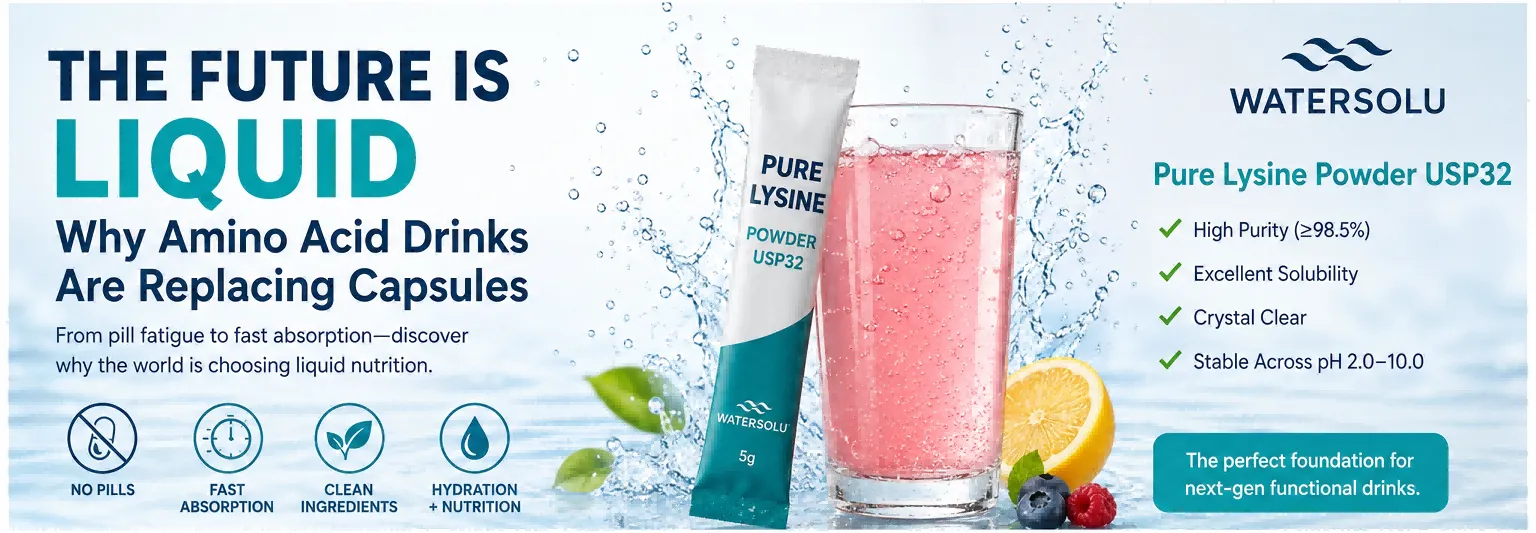
The global nutraceutical landscape is undergoing a massive paradigm shift. Consumers are increasingly rejecting the clinical, pill-swallowing experience of traditional capsules in favor of refreshing, RTD (Ready-to-Drink) functional beverages and instant hydration stick packs.
For brands and formulators, this shift introduces a critical technical bottleneck: how to transition hydrophobic, unstable amino acids-like L-Lysine-into flawless liquid delivery systems. This blog analyzes the drivers behind this capsule-to-liquid migration and details how Watersolu's Pure Lysine Powder USP32 provides the exact crystallization engineering needed to dominate this next-gen market.
The Reasons Behind the Shift
1 .The "Pill Fatigue" Phenomenon
A 2025 consumer survey found that 42% of regular supplement users report difficulty swallowing capsules, and over 60% admit to skipping doses when faced with multiple pills daily . This "pill fatigue" is especially pronounced among Gen Z and millennials, who prefer enjoyable consumption experiences.
2 .Faster Absorption & Bioavailability
Unlike capsules that must first disintegrate in the stomach, amino acid drinks are already in solution, allowing rapid absorption through the gastrointestinal tract. Clinical data suggest that liquid amino acid formulations can achieve peak plasma concentrations 15–30 minutes faster than equivalent capsule doses.
3 .Clean Label & No "Hidden" Excipients
Capsules often contain fillers, binders, lubricants (e.g., magnesium stearate), and artificial colors. By contrast, a well-formulated amino acid drink can contain just three ingredients: pure amino acid powder, natural flavor, and water. This transparency resonates strongly with health-conscious consumers.
4 .Customizable Dosing
With capsules, dosing is fixed (e.g., 500 mg per cap). Drinks allow consumers to easily adjust their intake-half a scoop, a full scoop, or anywhere in between. This flexibility appeals to athletes, biohackers, and everyday users alike.
5 .Hydration + Nutrition = Synergy
A functional amino acid drink delivers both essential nutrients and hydration in one convenient package. Post-workout, for example, athletes need both fluid replacement and muscle recovery support. An amino drink satisfies both needs simultaneously-something a capsule with a glass of water cannot achieve as elegantly.
Consumer Preference Comparison
Consumer Preference: Capsules vs. Amino Drinks (2025 Survey Data)
| ITEM | Capsules | Amino Drinks |
|---|---|---|
| Taste | 18% | 82% |
| Convenience | 40% | 60% |
| Absorption speed | 12% | 88% |
| No pills | 10% | 90% |
| Portability | 75% | 25% |
| Customizable dose | 5% | 95% |
Key Factors for a Superior Amino Acid Drink
1 .Solubility & Clarity
The biggest technical hurdle for amino acid drinks is complete dissolution without sedimentation. High-purity L-lysine HCl (≥98.5%) is freely soluble in water-at least 50 g/100 ml at 25°C-and fully dissolves in 30 seconds. This ensures a crystal-clear, pleasant-looking beverage.
2 .Taste Masking & Flavor Profile
Amino acids can have bitter or metallic notes. Successful products use natural fruit flavors (lemon, berry, tropical) and slight sweetening (stevia, monk fruit) to create a refreshing taste. pH adjustment to 3.0–4.5 also enhances both stability and palatability.
3 .Stability Across Temperature & pH
A market-ready amino drink must withstand refrigeration (4°C), ambient storage (25°C), and even brief temperature spikes during transport. L-Lysine HCl remains stable across pH 2.0–10.0 and up to 40°C without degradation-making it an ideal choice for ready-to-drink (RTD) formulations.
4 .Packaging & Consumer Experience
Single-serving sticks, resealable pouches, and RTD bottles are winning formats. They communicate modern, active lifestyle values. Packaging should also highlight "zero pills," "fast absorption," and "clean ingredients."
Formulation Checklist for Success
| Criterion | Capsule | Amino Drink | Why Drink Wins |
|---|---|---|---|
| Dissolution time | 10–30 min (in stomach) | 30 sec (in glass) | Instant availability |
| Absorption onset | 30–60 min | 10–15 min | Faster effect |
| Dosing flexibility | Fixed | Adjustable | Personalized nutrition |
| Consumer enjoyment | Low | High | Better compliance |
| Clean label potential | Moderate (excipients) | High (minimal ingredients) | Transparency |
| Portability | Excellent | Good (stick packs) | Trade-off accepted |
Solutions & Optimization Strategies
How to Develop a Winning Functional Amino Acid Drink
Step 1: Choose the Right Amino Acid Grade
Select pharmaceutical-grade, highly soluble amino acid powders. For lysine, demand ≥98.5% purity with USP32 compliance and zero excipients.
Step 2: Build a Base Formula
Start with a 5% solution (5g powder per 100ml water). Adjust pH to 3.5–4.0 using citric acid. Add natural flavor (0.1–0.5%) and a clean-label sweetener.
Step 3: Stability Testing
Conduct 3-month accelerated stability (40°C/75% RH) to confirm no precipitation, color change, or off-flavors.
Step 4: Consumer Sensory Panel
Blind taste tests against competitor capsule-in-water experiences. Aim for >80% preference for the drink format.
Practical Insights & Market Data
Real-World Success: The Rise of Ready-to-Drink Amino Beverages
Between 2023 and 2025, the functional amino acid drink category grew at a CAGR of 19.7% in North America and 28.4% in Asia-Pacific. Major sports nutrition brands have either launched or acquired RTD amino lines, while startups are entering the space with clean-label, no-sugar-added formulas.
Formulator's Experience: What Works and What Doesn't
| Approach | Outcome |
|---|---|
| Using low-purity amino powder → Sedimentation, bitter taste | ❌ Avoid |
| Adding artificial sweeteners → Consumer distrust | ❌ Avoid |
| High amino concentration (>10%) without flavor balancing → Poor palatability | ❌ Avoid |
| Using high-purity lysine + natural flavors + stevia → Crystal clear, great taste, high compliance | ✅ Recommended |
| Single-serve stick packs → Perfect for on-the-go lifestyle | ✅ Recommended |
Ready to Launch Your Functional Amino Acid Drink?
The market is shifting-consumers want pill-free, great-tasting, fast-acting nutrition. By choosing the right ingredients and formulation strategy, you can capture this wave and differentiate your brand.
Pure L-Lysine HCl Powder from certified manufacturers offers:
✅ USP32 compliance & ≥98.5% purity (99.3% typical)
✅ Zero excipients, binders, or fillers
✅ Full dissolution in 30 seconds at 25°C
✅ Stable across pH 2.0–10.0 and up to 40°C
✅ Certifications: ISO22000, HACCP, KOSHER, HALAL, FDA GRAS, Non-GMO
✅ Competitive pricing: 5%–18% lower than global alternatives
Contact us today for:
Free samples of pure L-lysine HCl powder
Certificate of Analysis (COA)
Custom formulation support for ready-to-drink or stick-pack products
Technical guidance on flavor masking and stability testing
FAQ

Q1: Are amino acid drinks as effective as capsules for muscle building?
Q2: Do amino acid drinks taste bitter? How can that be fixed?
Q3: How much amino acid powder should I use per serving of drink?
Q4: Are amino acid drinks suitable for children or pregnant women?
Q5: How do I store a homemade amino acid drink? Does it need refrigeration?
References
1.Keep Ingredients. Pure L-Lysine HCl Powder Product Page. USP32 Compliant, ≥98.5% Purity. Available at: https://www.watersolu.com/nutritional-ingredients/pure-lysine-powder.html
2.Nutrition Business Journal. State of the Sports Nutrition & Functional Beverage Market Report 2025. NBJ, 2025.
International Food Information Council (IFIC). 2025 Food & Health Survey: Consumer Attitudes Toward Supplement Formats. Washington, DC: IFIC, 2025.
3.Zhang, L., et al. Liquid vs. Solid Amino Acid Supplementation: A Randomized Crossover Trial on Postprandial Plasma Amino Acid Availability. Journal of the International Society of Sports Nutrition, 2025; 22(1): 100–112.
4.Consumer Reports National Research Center. Supplement User Survey: Pill Fatigue and Format Preferences. 2025; n=2,000.
5.Research and Markets. *Ready-to-Drink (RTD) Functional Beverages Market – Global Forecast to 2030*. Report ID: RM2025-782, 2025.
Smith, R. Formulation Strategies for Plant-Based and Amino Acid Functional Beverages. Beverage Industry Magazine, March 2025; pp. 32–3