
Introduction
In the rapidly growing global adaptogen market, ashwagandha root extract powder has emerged as a star ingredient. However, a critical question often overlooked by buyers and brands is: Which part of the plant does your powder actually come from?
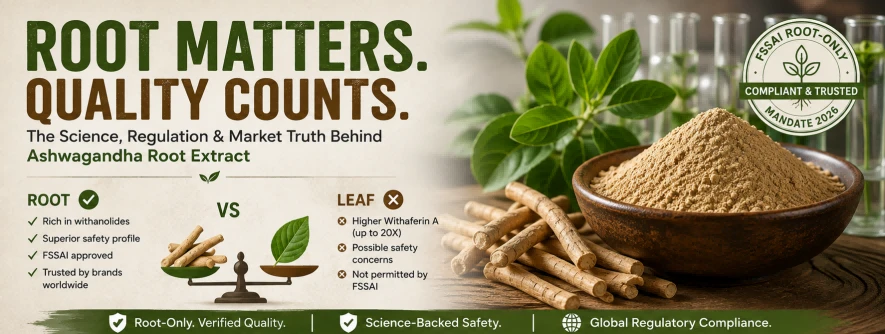
The distinction between root and leaf is not a minor detail. It is a matter of regulatory compliance, product safety, and consumer trust. As India's regulatory body FSSAI enforces a "root-only" mandate for ashwagandha supplements, understanding this issue has never been more important for anyone sourcing bulk ashwagandha root extract.
This article explores the science, regulation, and market reality behind the root vs. leaf debate, and explains why choosing a premium ashwagandha root powder extract from a trusted supplier is a strategic decision for your brand.
1. The Science: Why Root and Leaf Are Not the Same?
1.1 Different Chemical Profiles
Withania somnifera (ashwagandha) contains distinct phytochemical profiles in its root and leaf tissues. The root is rich in withanolides-the bioactive compounds responsible for the herb's adaptogenic properties. However, the leaf contains a different withanolide profile.
The key difference lies in Withaferin A, a specific withanolide found at significantly higher concentrations in the leaf. Independent studies and industry experts confirm that Withaferin A can be up to 20 times more concentrated in ashwagandha leaves than in the root . Similarly, withanone is roughly 6 times more abundant in leaves .
1.2 Safety Implications
These chemical differences are not merely academic. A 2025 AI-driven meta-analysis published in Frontiers in Nutrition concluded that ashwagandha root exhibits a superior safety profile compared to non-root parts, particularly concerning liver and reproductive toxicity . The study emphasized that while the root has decades of reassuring safety data, the same cannot be said for products that incorporate undisclosed leaf material .
The Ministry of Ayush's 2024 updated safety dossier, which triggered the FSSAI advisory, explicitly cited studies identifying "possible safety concerns for ashwagandha leaves due to higher concentrations of reactive withanolides, particularly withaferin A" . This scientific consensus is why regulatory bodies are now mandating root-only usage.
2. The Regulatory Landscape: What the FSSAI Advisory Means
2.1 The April 2026 Enforcement
On April 16, 2026, the Food Safety and Standards Authority of India (FSSAI) issued a formal advisory mandating that only ashwagandha roots may be used in Ayush drugs, dietary supplements, and nutraceutical products . This directive, aligned with the Ministry of Ayush, explicitly prohibited the use of leaves in any form-crude, extract, or derivative .
Importantly, this was not new legislation but an enforcement of existing rules. FSSAI Schedule IV has always permitted only the dried mature root of Withania somnifera in nutraceutical products. The 2026 advisory directed state authorities to enforce a rule that had been on the books for years .
2.2 What This Means for Global Buyers
While the FSSAI advisory directly affects manufacturers operating in or sourcing from India, its implications are global. India remains the world's primary supplier of ashwagandha raw materials. For international brands sourcing ashwagandha root extract powder bulk, this regulatory shift means:
Increased scrutiny on raw material authenticity and labeling
Risk of undeclared leaf inclusion (adulteration) becoming a compliance liability
Pressure to validate supply chains with independent testing
Even though U.S. and EU regulations remain unchanged, the global supply chain is experiencing heightened scrutiny around plant-part identity, labeling accuracy, and raw material traceability .
3. The Market Reality: Why Leaf Adulteration Happens
3.1 The Economic Incentive
The root vs. leaf issue is not just about science or regulation-it is also an economic reality. Data from India's largest wholesale auction market for ashwagandha (Neemuch's Krishi Upaj Mandi) reveals a striking disparity:
| Material | Volume (FY 2024-25) | Price per Ton |
|---|---|---|
| Leaves | 4,698 metric tons | ~$8.50 |
| Roots | 4,171 metric tons | ~$260 |
Leaf material is roughly 30 to 60 times less expensive than root material . This massive price gap creates a powerful incentive for unscrupulous suppliers to blend cheaper leaf extract into products sold as pure ashwagandha root powder extract.
3.2 The Testing Challenge
Adding to the problem is a critical analytical loophole. Ashwagandha leaves carry withanolides at concentrations 10 to 20 times higher than the root . When a supplier blends leaf extract into a root batch and runs a standard total withanolides assay, the adulterated material often passes the test and may even score higher on potency .
However, total withanolides is a blunt measurement. As industry experts point out, not all withanolide percentages are equal. A generic total withanolides figure, presented as a single number on a Certificate of Analysis (CoA), can include compounds from unspecified fractions quantified by unspecified methods . It cannot be independently verified by a third-party laboratory because there is no agreed reference point .
A truly reliable ashwagandha root powder specification should be verifiable against defined reference standards, such as those in the U.S. Pharmacopeia (USP) Withania somnifera Root Monograph, which identifies 10 specific withanolide compounds .
4. Choosing a Trusted Ashwagandha Root Extract Supplier
4.1 What to Look For
For brands sourcing ashwagandha root extract powder wholesale, the following criteria are essential:
Clear botanical source documentation: Your supplier should provide CoAs that explicitly state the plant part as Withania somnifera root. This documentation should come from an ISO/IEC 17025-accredited third-party laboratory, not just the supplier's own internal testing .
Defined withanolide specification: Ask what the withanolide percentage actually represents. A number without a defined test method tells you very little. The U.S. Pharmacopeia (USP) Withania somnifera Root Monograph provides a verifiable standard .
Low Withaferin A levels: A premium ashwagandha root extract powder 5% withanolides should also feature ultra-low Withaferin A levels (typically below 0.1%) as a safety indicator.
4.2 Our Commitment: Root-Only, Verified Quality
At Keep Ingredients Co., Ltd., our ashwagandha root extract powder is derived exclusively from the roots of Withania somnifera. We understand that trust is built on transparency and verifiable quality.
Our water-soluble ashwagandha root extract features:
Total Withanolides ≥5.0% (HPLC-tested)
Withaferin A ≤0.1% – well within safety limits
Debittered for superior palatability in gummies and beverages
Instant soluble – forms a transparent suspension in water
Full documentation including third-party CoA, Non-GMO, and FDA GRAS support
We hold ISO22000, BRC, HACCP, KOSHER, HALAL, and FDA certifications, ensuring our organic ashwagandha root extract powder meets the strictest global standards.
5. Conclusion
The root vs. leaf debate is not a niche concern-it is a fundamental issue of product integrity, consumer safety, and regulatory compliance. With the FSSAI root-only enforcement signaling a global shift toward stricter botanical identity standards , brands that invest in verified, root-only ashwagandha root powder extract are better positioned to mitigate risk and build long-term trust.
By choosing a supplier who prioritizes transparency and scientific rigor, you are not just buying an ingredient-you are protecting your brand reputation.
Looking for a Trusted Ashwagandha Root Extract Supplier?
We understand that sourcing ashwagandha root extract powder is about more than just specifications-it's about confidence. Confidence that your ingredient comes from the right plant part, that it's been tested rigorously, and that your supply chain is secure.
If you are a brand owner, formulator, or procurement professional seeking a reliable ashwagandha root extract manufacturer with verified root-only sourcing, transparent documentation, and global certifications, we would welcome the opportunity to discuss your needs.
We let our third-party test results and customer track record speak for themselves.
📞 Contact us for batch-specific COA, product samples, or to discuss your custom formulation requirements.
📩 Email: info@watersolu.com
📱 WhatsApp: +86 17396654828
References
1.FSSAI Advisory on Ashwagandha Root-Only Use (April 16, 2026). Food Safety and Standards Authority of India.
2.Ministry of Ayush Directive on Ashwagandha (April 15, 2026). Government of India.
3.Jain, P.K. (2026). "Shedding light on the ashwagandha leaf problem." SupplySide Supplement Journal.
4.Ronen, Y. et al. (2025). "Comprehensive safety evaluation of Withania somnifera (Ashwagandha): an AI-driven meta-analysis." Frontiers in Nutrition, Volume 12.
5.Shah, R.M. (2026). "What every brand using ashwagandha needs to know right now." SupplySide Supplement Journal.
6.Eurofins USA (2026). "Navigating Ashwagandha Root-Only Enforcement Through Analytical Precision."
7.Karnataka High Court Interim Stay Order on Ashwagandha Leaf Ban (May 2026). NutraIngredients.com.
8.U.S. Pharmacopeia (USP). Withania somnifera Root Monograph.