
Introduction
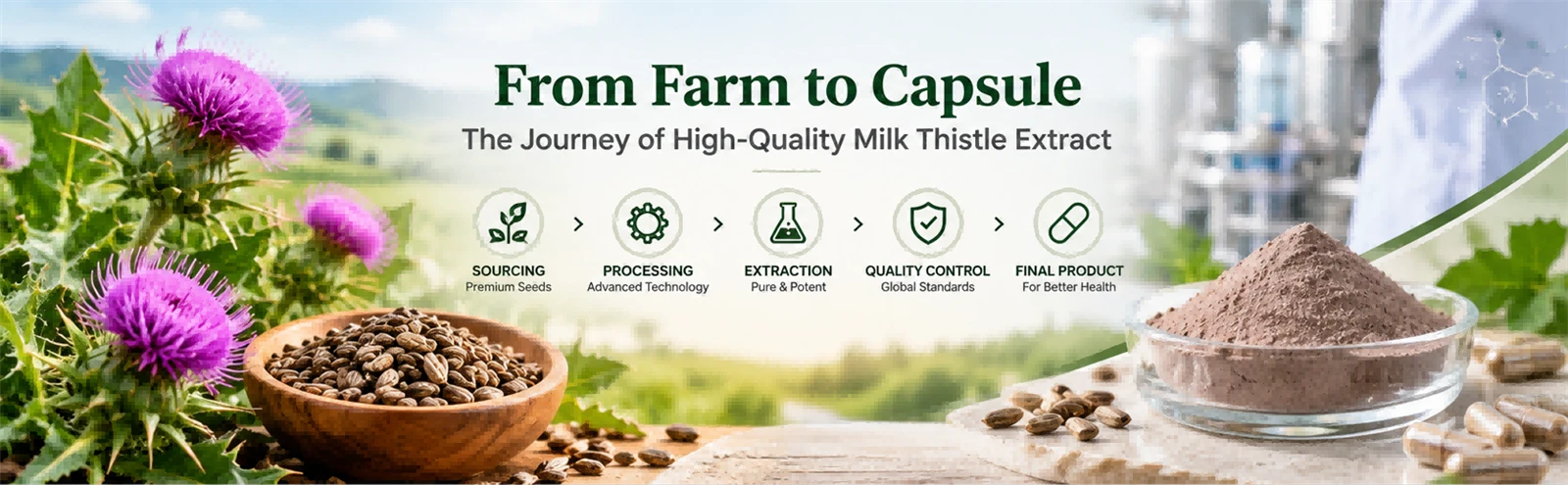
The journey of pure milk thistle extract from a humble seed to a high-quality finished product is a remarkable story of agricultural science, advanced extraction technology, and rigorous quality control. Understanding this journey helps consumers and businesses alike appreciate what goes into a truly superior milk thistle supplement. This article traces every critical step in the production of standardized milk thistle extract, from the farm to the final capsule, with a special focus on how China's mature manufacturing ecosystem delivers world-class milk thistle extract powder that competes on quality, not just price.
1. The Global Foundation: Sourcing the Right SeedsProducts Description
1.1 The Plant and Its Origins
Silybum marianum, commonly known as milk thistle, is an annual plant characterized by its distinctive purple composite flower heads and spiny leaves. Native to the Mediterranean region, it has adapted to cultivation in diverse climates worldwide. The plant's fruits-the seeds-serve as the starting material for milk thistle extract production.
1.2 A Balanced View of Global Growing Regions
While traditional European producers like Poland and Hungary have long histories of milk thistle cultivation, China has emerged as a major and reliable supplier of high-quality milk thistle seeds, particularly from the Heilongjiang, Inner Mongolia, and Gansu provinces. The vast, unpolluted farmlands and well-managed agricultural practices in these regions produce seeds with consistent silymarin content-often rivaling or exceeding European sources. Moreover, China's integrated supply chain means that the same quality seeds can be processed locally into finished bulk milk thistle extract with significantly shorter lead times and better cost efficiency.
For international buyers, the question is no longer "where does the seed come from" but "who controls the quality throughout the entire process." This is where China's milk thistle extract manufacturers have built a distinct competitive advantage.
1.3 Cultivation and Harvesting Practices
For top-tier milk thistle seed extract, cultivation follows precise agricultural protocols regardless of geography. In China's major growing regions, farmers have adopted modern agronomic techniques-including optimized sowing density, irrigation management, and pest control-to maximize both yield and silymarin content. The harvesting process is carefully timed, typically in late summer, to ensure peak active compound concentration. After windrowing and field drying, artificial drying reduces moisture content to below 8%, followed by cleaning through sieving, sifting, and gravity separation processes that achieve purity levels exceeding 99%.
1.4 Breeding Programs for Consistent Quality
China's agricultural research institutions have invested heavily in milk thistle seed breeding programs, developing chemotypes with optimized silymarin profiles. This scientific approach ensures that the raw material entering China's milk thistle extract production lines is not only abundant but also compositionally predictable-a critical factor for producing standardized milk thistle extract that meets international pharmacopoeia requirements batch after batch.
2. Primary Processing and Quality Control
2.1 Seed Preparation and Defatting
Once the milk thistle seeds have been thoroughly cleaned and dried, the primary processing phase begins. A crucial step involves mechanical pressing to reduce the fatty oil content of the seeds. This defatting process not only prepares the material for more efficient extraction but also increases the silymarin concentration of the resulting press cake. This is a foundational step in creating high-quality bulk milk thistle extract, and Chinese processing facilities have invested in state-of-the-art pressing equipment that ensures consistent results.
2.2 Incoming Material Verification
Before extraction can proceed, rigorous quality control measures are applied to every batch of raw seeds. China's leading milk thistle extract manufacturers operate ISO-accredited laboratories where testing includes identity verification, purity screening, pesticide residue analysis, and potency assessment. This stage is the first line of defense in ensuring that the final pure milk thistle extract meets the stringent specifications required for global nutraceutical markets.
3. The Extraction Process: Where Technology Makes the Difference
3.1 Advanced Solvent Extraction Technology
Extraction is the core of producing milk thistle extract powder. This process involves using food-grade solvents-typically ethanol or acetone-to separate the valuable silymarin complex from inert plant material. China's milk thistle extract production facilities have adopted world-class extraction technologies, including counter-current extraction systems that significantly enhance yield while minimizing solvent consumption. Some manufacturers have further optimized the process with ultrasonic-assisted extraction, achieving higher efficiency and better preservation of active compounds.
For international buyers sourcing pure milk thistle extract powder, the advantage of Chinese manufacturing lies in the combination of advanced equipment and experienced operators who fine-tune parameters for each batch to achieve optimal results.
3.2 Filtration, Concentration, and Purification
After extraction, the liquid containing the dissolved milk thistle actives undergoes multi-stage filtration to remove particulates. It is then concentrated using thin-film evaporators under carefully controlled temperature and vacuum conditions. The concentrated solution then undergoes a purification and enrichment stage. Chinese manufacturers have perfected these purification protocols to consistently achieve the European Pharmacopoeia-grade benchmark of minimum 80% silymarin content-a standard that premium pure milk thistle extract powder must meet.
3.3 Spray Drying to Powder
The final step in creating milk thistle powder extract is spray drying. The purified liquid concentrate is transformed into a fine, free-flowing powder. Advanced spray drying technology ensures uniform particle size, typically within the 80-200 mesh range, which optimizes the powder's solubility and handling properties. China's milk thistle extract manufacturers have invested in modern spray drying towers that deliver consistent bulk density and flow characteristics-critical parameters for downstream capsule filling and tableting operations.
3.4 Comprehensive Quality Assurance
Comprehensive quality assurance is paramount throughout the entire production cycle. China's top-tier manufacturers operate under GMP (Good Manufacturing Practice) standards, with in-house laboratories equipped with HPLC (High-Performance Liquid Chromatography) and GC (Gas Chromatography) systems. Every batch of milk thistle extract supplement undergoes testing for:
Active compound profile (silymarin, silybin A and B, etc.)
Heavy metals (lead, arsenic, mercury, cadmium)
Pesticide residues (multiple residue screens)
Microbial contamination (total plate count, yeast, mold, pathogens)
Residual solvents (meeting USP/EP limits)
Many leading Chinese suppliers also offer third-party testing through globally recognized laboratories such as SGS and Eurofins, providing an additional layer of transparency for international clients sourcing milk thistle extract capsules or powder.
4. Formulation, Encapsulation, and Packaging
4.1 Creating Diverse Dosage Forms
The milk thistle extract powder can be formulated into various finished products. Common forms include milk thistle capsules, tablets, soft gels, and liquid extracts. In capsule production, the powder is precisely filled into vegetable or gelatin capsules using high-speed automated filling machines. China's manufacturing infrastructure supports both small-batch custom formulations and large-scale commercial production, offering flexibility for brands of all sizes.
Advanced formulations may combine milk thistle extract with complementary ingredients like dandelion extract, artichoke extract, turmeric root extract, or L-cysteine hydrochloride to create specialized liver support supplement blends. Chinese manufacturers have extensive experience in custom formulation development, working closely with clients to meet specific market requirements.
4.2 Bioavailability Enhancement Technologies
A key challenge with conventional milk thistle extract is its low bioavailability due to poor water solubility. To address this, advanced manufacturers-including several in China-use technologies like phospholipid complexation, which creates a complex that balances lipid and water solubility, significantly improving absorption. These enhanced formulations are particularly valued for high-end milk thistle supplement products targeting discerning consumers.
4.3 Packaging and Stability Testing
Proper packaging is essential for maintaining product integrity. Milk thistle extract powder is moisture-sensitive and should be stored below 10% moisture to prevent degradation. Standard packaging uses multi-layer bags with moisture barrier properties, ensuring the product maintains its shelf life of 18-24 months under proper storage conditions. China's manufacturers conduct accelerated stability studies and real-time stability monitoring to validate shelf-life claims-providing documented evidence that the pure milk thistle extract retains its potency throughout its intended shelf life.
5. Why China Stands Out as a Milk Thistle Extract Supplier
Beyond the technical capabilities described above, China offers several distinct advantages for international buyers of milk thistle extract bulk:
Integrated supply chain: From seed sourcing to final packaging, all stages can be managed within one country, reducing logistics complexity and lead times.
Cost competitiveness: China's mature chemical and pharmaceutical infrastructure enables economies of scale that deliver competitive pricing without compromising quality.
Regulatory compliance: Leading manufacturers maintain certifications including ISO 9001, ISO 22000, HACCP, Halal, Kosher, and organic certifications applicable to specific markets.
Responsive R&D: Chinese manufacturers offer agile custom formulation services, adapting to emerging market trends and client-specific requirements.
Global export experience: Many Chinese milk thistle extract suppliers have extensive experience exporting to North America, Europe, Japan, and Southeast Asia, understanding the documentation, labeling, and regulatory requirements of each destination market.
Conclusion
The journey from seed to capsule for pure milk thistle extract is a complex, multi-stage process where quality is determined not by geography but by technology, discipline, and quality systems. China's milk thistle extract manufacturers have built a world-class ecosystem that competes on quality, consistency, and innovation-not just cost. By understanding this complete journey, buyers can make informed decisions when sourcing standardized milk thistle extract and partner with suppliers who deliver genuine value at every step of the supply chain.
Interested in Learning More? Let's Talk Quality.
We hope this deep dive into the journey of pure milk thistle extract has given you a clearer picture of what truly separates a premium product from an average one. At the end of the day, great supplements start with great manufacturing-and that means transparency, science, and a commitment to consistency.
If you are a brand owner, formulator, or procurement professional looking for a reliable milk thistle extract supplier who prioritizes quality at every stage-from seed selection to finished capsules-we would welcome the opportunity to discuss your specific needs.
We don't believe in hard selling. We believe in sharing what we know, answering your questions honestly, and letting our products speak for themselves.
Whether you are exploring custom formulations, need help navigating regulatory requirements for different markets, or simply want to understand more about our quality control protocols-our technical team is here to help.
👉 Reach out to us with your questions, and we will respond with data, not fluff.
📩 Email: info@watersolu.com
📱 WhatsApp: +86 17396654828
References
1.Zhao, J. et al. (2025). Advancements in extraction and bioavailability enhancement of silymarin from Silybum marianum: A comprehensive review. Journal of Ethnopharmacology, 320, 117-129.
2.European Pharmacopoeia Commission. (2023). Milk Thistle Fruit Dry Extract (Monograph 04/2022:1868). European Pharmacopoeia 11.0 Edition.
3.USDA Agricultural Research Service. (2024). Germplasm Resources Information Network (GRIN) – Silybum marianum (L.) Gaertn. Available at: https://npgsweb.ars-grin.gov
4.National Institutes of Health (NIH) – Office of Dietary Supplements. (2023). Milk Thistle: Fact Sheet for Health Professionals. Available at: https://ods.od.nih.gov/factsheets/MilkThistle-HealthProfessional/
5.Chinese Pharmacopoeia Commission. (2020). Pharmacopoeia of the People's Republic of China (2020 Edition) – Milk Thistle Fruit Extract. China Medical Science Press.
6.Liu, W. & Zhang, H. (2024). Current status and prospects of milk thistle cultivation and processing industry in China. Chinese Journal of Medicinal Plants, 43(2), 45-52.
7.ISO 22000:2018. Food safety management systems – Requirements for any organization in the food chain. International Organization for Standardization.
8.Kvasnička, F. et al. (2023). Analytical methods for the determination of silymarin in plant material and dietary supplements – A critical review. Analytical and Bioanalytical Chemistry, 415, 2145-2160.
9.World Health Organization (WHO). (2022). WHO monographs on selected medicinal plants – Volume 4: Silybum marianum. Geneva: WHO Press.
10.SGS Global Testing Database. (2024). Typical test parameters for milk thistle extract – heavy metals, pesticides, and microbial limits. Internal industry reference.