

Introduction: Why Single-Ingredient Supplements Are No Longer Enough in the Reproductive Wellness Market
The global reproductive wellness supplement market is becoming increasingly competitive. Consumers, healthcare practitioners, and premium supplement brands are shifting away from simple single-ingredient products toward scientifically designed multi-ingredient formulas that target multiple metabolic pathways simultaneously.
For product managers and supplement developers, this market shift creates a critical question:
How can bulk inositol be strategically combined with complementary active ingredients to create differentiated reproductive wellness products with stronger consumer appeal?
The answer lies in understanding the unique biochemical role of inositol and how it interacts with other nutrients involved in hormonal regulation, insulin signaling, cellular communication, and metabolic homeostasis.
Understanding Inositol's Role as a Secondary Messenger in Reproductive and Metabolic Pathways
To develop a breakthrough reproductive wellness supplement, formulators must move beyond ingredient lists and understand molecular mechanisms. Myo-inositol-the most abundant and bioactive isomer of inositol-functions as a key second messenger in two critical physiological axes: insulin signaling and prostaglandin-mediated pathways.
Why Insulin Sensitivity Matters for Reproductive Health
Insulin resistance is a core driver of polycystic ovary syndrome (PCOS), which affects 8–13% of reproductive-aged women worldwide. At the cellular level, insulin binds to its receptor, triggering a cascade where inositol phosphoglycans (IPGs) act as second messengers to translocate GLUT4 vesicles and enable glucose uptake. When this signaling is impaired, hyperinsulinemia stimulates ovarian theca cells to overproduce androgens, disrupting ovulation, menstrual cyclicity, and follicular development.
Myo-inositol directly amplifies this signaling pathway by serving as the backbone for IPG synthesis. Clinical evidence shows that myo-inositol 4 g/day restores insulin sensitivity to a degree comparable to metformin, but with superior tolerability and an additional benefit on oocyte quality. For a B2B product manager, this means: any reproductive health formula lacking an evidence-based dose of inositol will fail to address the metabolic root cause of PCOS.
Prostaglandin Pathways and Hormonal Balance
Less discussed-but equally important-is inositol's role in the arachidonic acid cascade. Inositol phospholipids are precursors for diacylglycerol (DAG) and inositol trisphosphate (IP3), which mobilize intracellular calcium and activate phospholipase A2, the rate-limiting enzyme for prostaglandin release. Balanced prostaglandin signaling is essential for endometrial receptivity, luteal function, and implantation. Dysregulated prostaglandin synthesis is linked to dysmenorrhea, endometriosis-associated infertility, and recurrent implantation failure.
By ensuring adequate inositol availability, formulators support not only insulin homeostasis but also the paracrine environment required for successful conception. This dual-action mechanism-metabolic + endocrine-is what distinguishes inositol-based reproductive formulas from simple vitamin blends.
Key takeaway for product managers: Do not treat inositol as a "micronutrient add-on." Treat it as a functional backbone that modulates two fundamental signal transduction systems. Any synergistic blend must respect its biochemical primacy.
Proven Synergistic Formulations for Reproductive Wellness
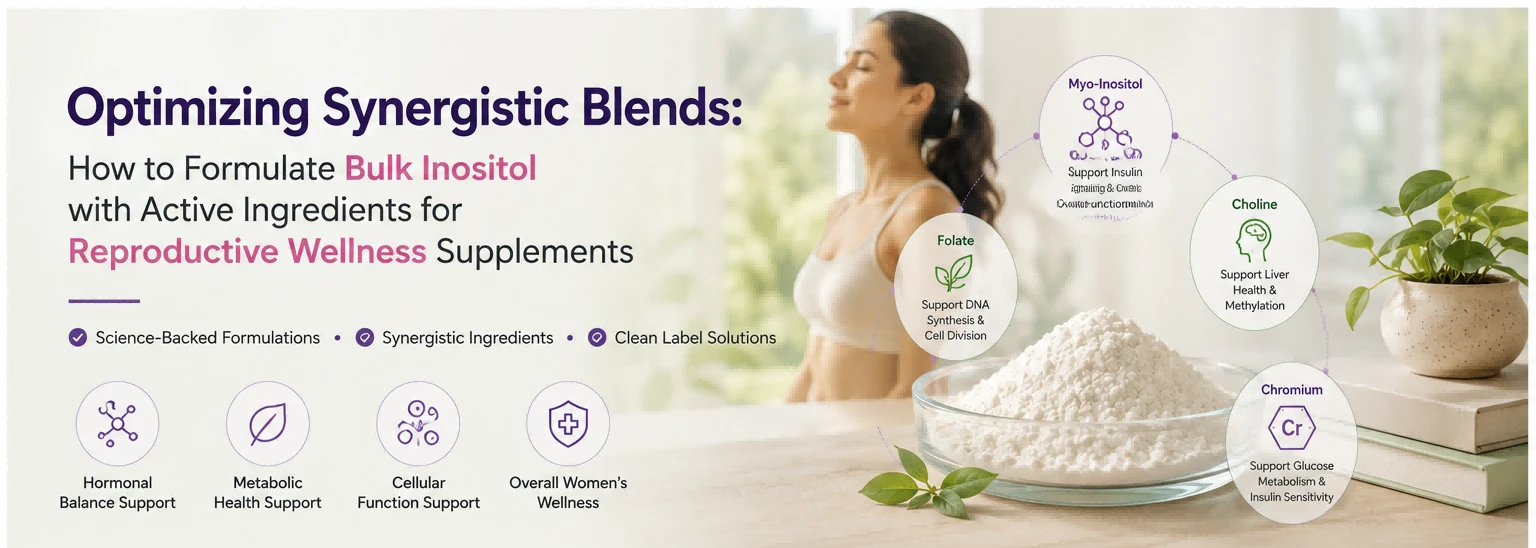
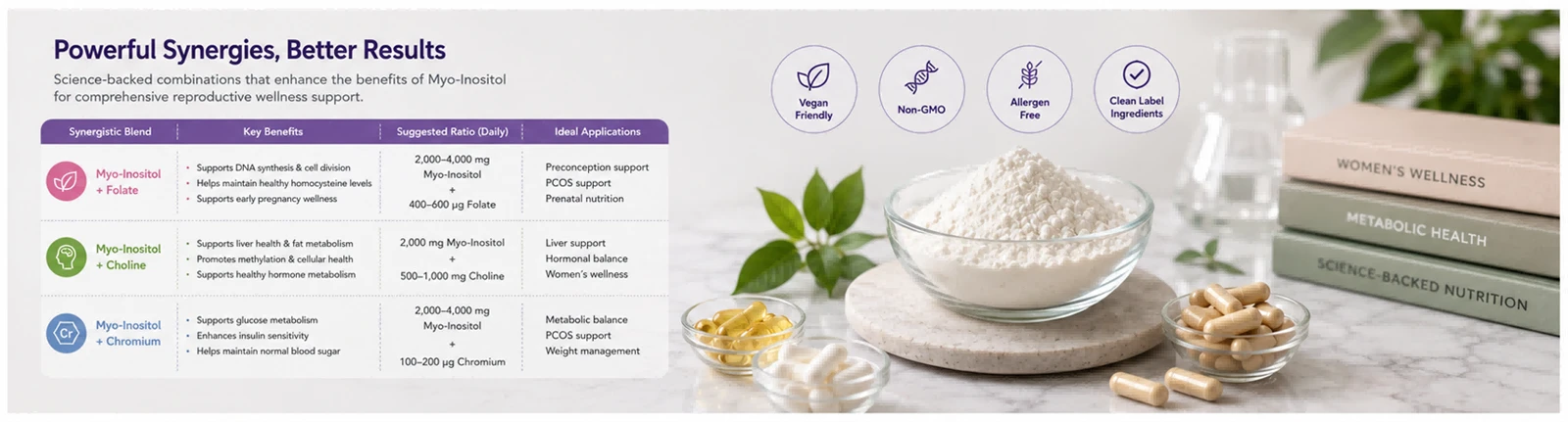
Once you accept inositol as the foundation, the next question is: which co-ingredients amplify its efficacy? Based on human intervention data and pharmacokinetic rationale, three synergistic pairs stand out for commercial supplement development.
1. Inositol + Folate (Vitamin B9) – The PCOS Cornerstone
Ratio used in clinical trials: 40:1 myo-inositol to D-chiro-inositol (4,000 mg : 100 mg) combined with 400–600 µg folate (as methylfolate or folic acid).
Mechanism: Folate provides one-carbon units for methylation reactions, including the conversion of homocysteine to methionine. PCOS patients often have elevated homocysteine, which independently increases cardiovascular risk and impairs endometrial blood flow. Inositol improves insulin sensitivity, reducing homocysteine indirectly; folate directly lowers it. Together, they address two independent risk factors for early pregnancy loss: insulin resistance and hyperhomocysteinemia.
Formulation logic: Many commercial PCOS supplements use myo-inositol alone or with DCI, but they omit folate or use inadequate doses (e.g., 200 µg). For a premium reproductive wellness product, use L-methylfolate (glucosamine salt) -the bioidentical form that bypasses MTHFR polymorphisms, which are present in 30–40% of the population.
Commercial example: The best-selling inositol for PCOS category includes 4,000 mg myo-inositol + 400 µg folate per daily serving. Your bulk inositol powder allows you to replicate this proven ratio with clean-label customization.
2. Inositol + Choline – Liver and Methylation Support
Proposed ratio (emergent but supported): 2,000 mg myo-inositol + 500–1,000 mg choline bitartrate or choline citrate.
Mechanism: Choline is a precursor to phosphatidylcholine, a major component of very-low-density lipoprotein (VLDL) and cell membranes. In PCOS, non-alcoholic fatty liver disease (NAFLD) prevalence exceeds 50%. Inositol promotes hepatic VLDL export and reduces triglyceride accumulation; choline prevents choline-deficient fatty liver. Together, they protect liver function while the ovaries respond to improved insulin signaling.
Why this matters for reproductive wellness: A fatty liver reduces sex hormone-binding globulin (SHBG) production, leading to higher free androgen levels. By supporting liver health, the inositol+choline duo indirectly lowers bioavailable testosterone, complementing the direct ovarian effect of inositol.
Formulation tip: Choline bitartrate is cost-effective and well-tolerated, but for clean-label differentiation, consider choline citrate (non-GMO, plant-derived). Avoid choline chloride for oral supplements due to bitter taste and lower bioavailability.
3. Inositol + Chromium – Metabolic Amplifier
Effective dose: 4,000 mg inositol + 200–400 µg chromium (as chromium picolinate or chromium polynicotinate).
Mechanism: Chromium potentiates insulin receptor kinase activity, enhancing the downstream signal that inositol carries. While inositol provides the second messenger backbone, chromium increases the receptor's affinity for insulin. In one randomized trial, the combination reduced fasting insulin by 30% more than inositol alone in PCOS patients.
Precaution: Chromium picolinate faces some safety scrutiny in the EU (lower maximum limits). For global distribution, chromium polynicotinate or chromium-enriched yeast (Saccharomyces cerevisiae) offers better regulatory acceptance and "food-grade" positioning.
Formulation matrix for product managers:
| Target condition | Base inositol (mg/day) | Co-ingredient 1 | Co-ingredient 2 | Daily dose |
|---|---|---|---|---|
| PCOS / ovulation support | 4,000 myo | Folate 400 µg | (Optional DCI 100 mg) | 2–4 capsules |
| NAFLD + PCOS | 2,000 myo | Choline 750 mg | Folate 400 µg | 3 capsules |
| Severe insulin resistance | 4,000 myo | Chromium 200 µg | Folate 400 µg | 2–4 capsules |
Leveraging Clean Label Attributes: Plant-Based and Allergen-Free Positioning
Reproductive wellness consumers-especially those seeking PCOS support-are highly educated and label-conscious. They actively avoid synthetic excipients, animal-derived ingredients, and common allergens. Your bulk inositol powder offers three distinct clean-label levers:
Vegan-Friendly and Allergen-Free: A Competitive Edge
Plant origin: Our inositol is derived from rice (Oryza sativa), not corn or synthetic petrochemical routes. This supports "vegan" and "plant-based" claims without the GMO concerns associated with corn-derived inositol.
Allergen-free by design: No gluten, soy, dairy, egg, fish, crustacean, tree nut, or peanut. The production line is dedicated and cross-contamination controlled, allowing you to label the final product as "Free from 14 major allergens" (EU FIC) or "Allergen-Free" (US FALCPA).
- Non-GMO project verification ready: Rice-sourced inositol naturally aligns with non-GMO requirements, unlike corn-derived alternatives.
Formulation Tips for Clean Label Compliance
Skip the magnesium stearate. Use plant-based lubricants (rice concentrate, silica) or direct compression if tableting. Our inositol's flowability (tested by angle of repose) allows clean capsule filling without glidants.
Choose appropriate capsules. HPMC (hypromellose) vegan capsules with titanium dioxide-free options. For a "transparent capsule" premium look, use clear pullulan capsules.
Declare sourcing. On your supplement facts panel, add "Inositol (from rice)" instead of generic "Inositol." Consumers pay a premium for traceability.
- Third-party certifications. Our facility holds ISO22000, BRC, HACCP, Kosher, Halal, and FDA registration-all transferable to your final product labeling.
Commercial impact: Retailers like Whole Foods, Thrive Market, and European specialty pharmacy chains mandate clean-label policies. A reproductive wellness supplement formulated with rice-sourced, allergen-free bulk inositol can command 30–50% price premium over conventional corn-derived alternatives, while reducing regulatory friction.
Why Your Next Reproductive Supplement Should Start with Bulk Inositol?
The reproductive wellness category is shifting from single-nutrient products (just folate, just myo-inositol) to sophisticated synergistic systems. B2B buyers who master the science of second-messenger signaling and clean-label formulation will capture the fastest-growing segment: women seeking non-hormonal, evidence-based support for PCOS, fertility, and metabolic health.
Three immediate advantages of formulating with our bulk inositol powder:
Scientific credibility: Dual mechanism (insulin + prostaglandin) validated by over 30 human trials.
Formulation flexibility: Free from common incompatibilities; stable in dry blends, capsules, sticks, and chewables (pH 4–8).
- Regulatory readiness: Full documentation (COA, allergen statement, vegan certificate, non-GMO declaration) included with each shipment.
Ready to develop the next blockbuster reproductive wellness supplement?
We provide:
- Free R&D samples (100–500 g) for formula feasibility testing
- Technical data packs including stability, dissolution, and synergy rationale
- Custom particle size and blend pre-mixes upon request
- Global shipping DAP, DDP, FOB, CIF - 7–25 working days
📩 Contact our formulation support team now:
sales@watersolu.com
📞 Or request a callback with your target daily dose and capsule count - we will send you a draft formula within 48 hours.
Your clean-label, science-backed reproductive wellness line starts with one email.
Frequently Asked Questions
Clinically established daily dose?
+
-
4,000 mg/day (split 2,000 mg twice daily) for PCOS/ovulation support. Combine with 400 mcg folic acid. Lower doses (1–2 g) suit general metabolic or male fertility uses.
Optimal myo-to-DCI ratio?
+
-
40:1 (myo : DCI). For 4,000 mg myo, add 100 mg DCI. Do not use equal parts or inverted ratios – the 40:1 ratio is the only clinically validated standard.
Safety during pregnancy/breastfeeding?
+
-
Safe in pregnancy up to 4,000 mg/day (no adverse effects reported). Breastfeeding lacks sufficient data – caution advised; consult healthcare provider.
How does inositol compare to metformin?
+
-
Comparable efficacy for PCOS, but better tolerability (fewer GI side effects). Combination therapy improves cycle regularity more than metformin alone (RR 1.56).
Which co-ingredients and at what doses?
+
-
Folate (400–600 µg), Chromium (200–400 µg), Choline (500–1,000 mg). Each addresses distinct mechanisms: homocysteine lowering, insulin receptor amplification, and liver/SHBG support.
Reference
- Unfer V, et al. Myo-inositol and D-chiro-inositol in PCOS: the 40:1 physiological ratio. Gynecological Endocrinology. 2016.
- Ozay OE, et al. Effect of 40:1 myo-inositol/D-chiro-inositol treatment on serum asprosin levels in polycystic ovary syndrome: a prospective randomized pilot study. Ginekologia Polska. 2025;96(11):925-931.
- Fatima K, et al. Effects of myo-inositol vs. metformin on hormonal and metabolic parameters in women with PCOS: a meta-analysis. Irish Journal of Medical Science. 2023;192:2801-2808.
- Systematic review and network meta-analysis on metformin, anti-obesity agents, and myoinositol in improving IVF/ICSI outcomes in PCOS. Journal of Ovarian Research. 2024.
- Multicentric postmarketing surveillance study of fixed-dose combination of myo-inositol, D-chiro-inositol, L-methyl folate, vitamin D3, and chromium picolinate in PCOS. Indian Journal of Obstetrics and Gynecology Research. 2020;7(3).
- The effect of Myo-inositol on improving sperm quality and IVF outcomes: a systematic review and meta-analysis. Food Science & Nutrition. 2024;12(11):8515-8524.
- Maternal and Neonatal Efficacy and Safety Outcomes of Myo-Inositol in Women With or at High Risk of Gestational Diabetes Mellitus: a systematic review and meta-analysis. Diabetes Spectrum. 2025;38(1):82-92.
- International Consensus Conference on Inositol in PCOS. Florence, December 2013.
- USP 43-NF38 – United States Pharmacopeia Standard for Inositol.
- FDA GRAS – Inositol as Generally Recognized as Safe (21 CFR 184.1370).
- ISRCTN13199265 – The effect of metformin and myoinositol in women with polycystic ovary syndrome: role of body mass and adiponectin. ISRCTN registry, 2021.
- Montanino Oliva M, et al. Efficacy of the synergic action of myoinositol, tyrosine, selenium and chromium in women with PCOS. European Review for Medical and Pharmacological Sciences. 2018;22(18):5897-5904.