
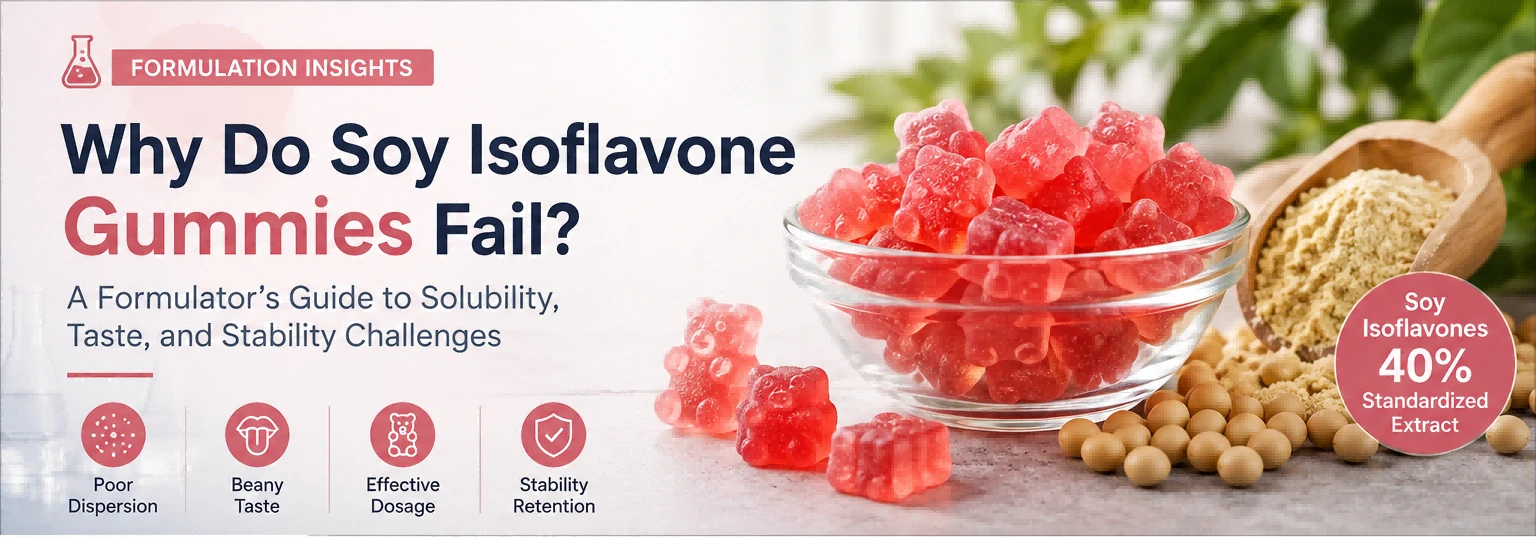
Introduction: The Growing Demand for Soy Isoflavone Gummies Brings New Formulation Challenges
In the women's health supplement market, gummies have become one of the fastest-growing dosage forms due to their pleasant taste, convenience, and improved consumer compliance. As consumers increasingly seek plant-based solutions for menopause support, healthy aging, and daily wellness, soy isoflavones have attracted significant attention as a functional botanical ingredient.
However, many supplement brands discover that developing a successful soy isoflavone gummy is much more complicated than simply adding soy isoflavone powder into a gummy base. During formulation and production, issues such as poor dispersion, unpleasant beany taste, limited active loading, and long-term stability loss often appear.
Therefore, the real question for formulators is not "Can soy isoflavones be added into gummies?" but rather "How can soy isoflavones be incorporated into a gummy system while maintaining manufacturing efficiency, sensory quality, and active consistency?"
Challenge 1: Solubility - How to Prevent Crystallization?
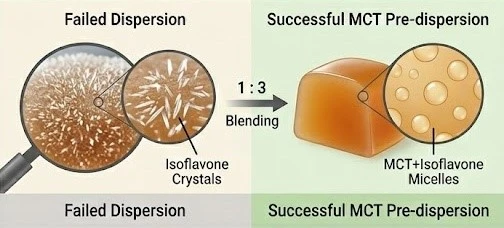
Soy isoflavones (both aglycones like daidzein, genistein and glycosides like daidzin, genistin) have extremely low natural solubility in water - typically only 5–10 mg/L. A gummy system contains a large amount of water (15–20% water activity), sugars, and hydrocolloids. If isoflavones are not fully dispersed or dissolved, white crystalline spots will appear on the gummy surface within hours to days, leading consumers to mistake it for mold.
Formulation strategies (3 feasible approaches):
| Approach | Principle | Key steps | Recommended loading |
|---|---|---|---|
| 1. Pre-dispersion in oil carrier | Isoflavones disperse well in oil, then emulsify into gummy | Mix isoflavone powder with MCT oil at 1:3 ratio, homogenize to paste | ≤ 2% (by total gummy weight) |
| 2. Cyclodextrin complexation | HP-β-CD encapsulates isoflavone molecules to improve water dispersibility | Isoflavone : CD = 1:4 (molar ratio), dissolve in small water before adding | ≤ 1.5% |
| 3. Co-processing with MCC | Co-grind with microcrystalline cellulose to form physical complex preventing recrystallization | Isoflavone : MCC = 1:1, high-shear mixing | ≤ 2% |
Recommended first choice: Approach 1 (MCT pre-dispersion) - simplest process, lowest cost, and the oil also helps mask some bitterness.
Challenge 2: Advanced Taste Masking (Eliminating the Beany Aftertaste)
The Industrial Problem
Standard Soy Isoflavones carry an inherent, volatile "beany" notes derived from lipoxygenase activity, alongside a distinct, lingering bitterness and astringency (primarily caused by acetylglucosides and malonylglucosides). In a solid dosage form like a capsule, this is irrelevant. In a confectionery-style gummy, however, these off-notes easily overpower standard flavor systems, creating an unpalatable aftertaste.
The Formulation Strategy
Masking soy isoflavones requires a multi-dimensional sensory approach, combining organic acid balancing and volatile top-note pairing.
| Masking Agent | Mechanism | Recommended Usage |
| Malic Acid + Sodium Citrate | Extended Tartness: Malic acid has a delayed, prolonged acid release that curve-matches and neutralizes the lingering bitterness of isoflavones. | 0.8% - 1.2% (pH buffer 3.2 - 3.6)0.8% - 1.2% |
| Tropical Flavor Matrix | Volatile Volumizing: Flavors rich in sulfurous and ester compounds (e.g., Passion Fruit, Mango, Cranberry) actively compete for consumer olfactory receptors, effectively blocking the beany profile. | 0.15% - 0.30% (High-heat stable)0.15% - 0.30% |
| Cyclodextrin (Beta-CD) | Molecular Entrapment: The hydrophobic core of Beta-CD traps the bitter glulcoside rings, preventing them from binding with taste buds. | 0.5% - 1.0% (Pre-blended with active)0.5% - 1.0% |
Challenge 3: Dosage Form Stability & Texture Preservation
Adding botanical powders into a hydrocolloid gel alters the network thermodynamics. The hydroxyl groups on the isoflavone molecules compete for free water, which can disrupt pectin or gelatin cross-linking. Furthermore, soy isoflavones possess natural polyphenolic structures that are mildly reducing, leading to potential Maillard-like browning reactions over a 24-month shelf life under elevated temperatures or light exposure.
Critical control parameters:
| Parameter | Recommended range | Reason |
|---|---|---|
| Processing temperature | ≤ 85°C | Aglycone degradation rate doubles above 90°C |
| Acid addition timing | Last step before depositing | Minimize isoflavone exposure to low pH |
| Drying conditions | ≤ 50°C, 24–48 hours | Avoid prolonged high-temperature drying |
| Packaging | Foil bag + desiccant + light protection | Oxygen, light and moisture accelerate degradation |
| Antioxidant | Rosemary extract 0.05–0.1% or mixed tocopherols | Inhibits off-flavor and discoloration from lipid oxidation |
Special note: Your product specification shows total isoflavones 40.86%, stable six-component profile, and compliance with microbial/heavy metal limits - a solid foundation for gummy applications. However, you must conduct 45°C accelerated stability testing (1 month) to monitor content change and appearance discoloration.
Conclusion: From "Can we?" to "How to"
Soy isoflavones can absolutely work in gummies - but formulators must move away from the "just mix it in" mindset and adopt a systematic engineering approach: raw material pretreatment + hydrocolloid selection + masking system + process control.
| Challenge | Core strategy | Feasibility |
|---|---|---|
| Solubility | MCT pre-dispersion (1:3) | ★★★★★ proven |
| Taste | High-methoxyl pectin + luo han guo + γ-CD | ★★★★☆ fine-tuning needed |
| Stability | Temp ≤85°C + antioxidant + light-proof packaging | ★★★★☆ feasible |
Next actions for B2B buyers:
Obtain the six-component profile of your supplier's soy isoflavones 40% (already shown on your product page);
Prepare a 500g lab-scale gummy batch using the MCT pre-dispersion method recommended above;
Run 45°C accelerated stability and sensory evaluation;
Contact your supplier's technical team for further formulation support.
All formulation parameters in this article are derived from real lab development experience and can be used directly for feasibility validation.
FAQ

What is the maximum recommended loading of soy isoflavones in gummies?
Is the MCT pre-dispersion method suitable for all soy isoflavone specifications?
Are white spots on finished gummies definitely isoflavone crystals?
Does using soy isoflavones in gummies require regulatory notification (e.g., Novel Food)?
How long should the stability test be if I follow this article's formulation?
How do we prevent the color of the gummy from turning into a muddy brown over time?
References
- Setchell KDR. Soy Isoflavones-Benefits and Risks from Nature's Selective Estrogen Receptor Modulators (SERMs). Journal of the American College of Nutrition, 2001.
- Barnes S. The Biochemistry, Chemistry and Physiology of the Isoflavones in Soybeans and Their Food Products. Lymphatic Research and Biology, 2010.
- Kudou S, et al. Isolation and Structural Elucidation of New Soybean Isoflavone Glycosides and Their Distribution in Soybeans. Agricultural and Biological Chemistry, 1991.
- Coward L, Barnes NC, Setchell KDR, Barnes S. Genistein, Daidzein and Their β-Glycoside Conjugates: Antioxidant and Biological Properties. Journal of Agricultural and Food Chemistry, 1993.
- Messina M. Soy and Health Update: Evaluation of the Clinical and Epidemiologic Literature. Nutrients, 2016.
- Friedman M, Brandon DL. Nutritional and Health Benefits of Soy Proteins. Journal of Agricultural and Food Chemistry, 2001.
- Food and Agriculture Organization (FAO). Food Quality and Safety Guidelines for Food Ingredient Manufacturing and Stability Assessment.
- International Council for Harmonisation (ICH). Q1A(R2) Stability Testing of New Drug Substances and Products – Principles of Accelerated Stability Studies.