
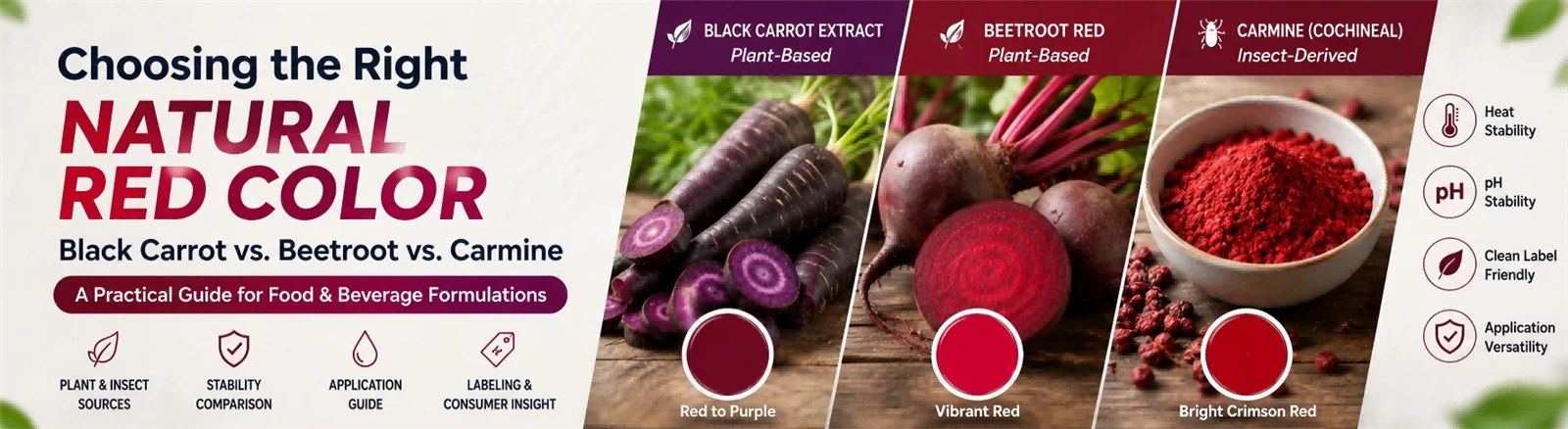
For procurement managers and R&D teams, the choice among natural red colorants is more than a sourcing decision-it's a strategic formulation challenge.
The global push away from synthetic dyes has created a new dilemma: with natural red colorants from multiple plant and insect sources available, each with distinct technical profiles and labeling implications, how do you determine which one is right for your specific application?
This guide provides a systematic framework for comparing the three most widely used natural red colorants: Black Carrot Extract, Beetroot Red, and Carmine (Cochineal). By the end, you'll have a clear methodology for evaluating these options against your product requirements.
Why Choosing Natural Red Colors Is So Difficult?
Unlike synthetic dyes, natural pigments are biologically derived compounds that react differently to heat, pH, oxygen, and light exposure.
Choosing the wrong ingredient often leads to fading, browning, precipitation, regulatory issues, or consumer rejection.
For B2B buyers, understanding these trade-offs before commercialization is essential.
Comparison Table: Which Natural Red Is Right for You?
Beetroot Red (Betalain-based)
Source: Extracted from red beet (Beta vulgaris) roots.
Color Profile: Produces a vibrant pink to red hue, visually intense and appealing .
pH Stability: Stable in the pH range of approximately 3.5–8.0 . Within this range, the color remains relatively consistent, making it suitable for a moderate variety of applications.
Heat Stability: This is the primary limitation. Beetroot red has low heat stability and degrades significantly during high-temperature processing, such as UHT treatment .
Suitable Applications: Best suited for products that do not require intensive heat processing. Common uses include ice cream, yogurt, dry mix powders, and certain confectionery items where processing temperatures remain low .
Clean-Label & Consumer Perception: Plant-based and vegan-friendly. No allergen-related concerns. However, its heat sensitivity often requires formulation adjustments or protective measures.
Relative Cost: Generally lower cost compared to carmine.
Carmine / Cochineal (Carminic Acid)
Source: Derived from the female cochineal insect (Dactylopius coccus) .
Color Profile: Delivers a vibrant, bright red often described as "Ferrari Red." It can achieve a range of shades from orange-red to blue-red depending on formulation and pH, with excellent intensity . It is arguably the most difficult red to replicate with plant-based alternatives.
pH Stability: Very good stability across a broad pH range, from approximately 3.0 to 11.0 . This makes it one of the most versatile natural red colorants in terms of application.
Heat Stability: Excellent. Carmine maintains its color integrity under high-temperature processing, including UHT, pasteurization, and baking .
Suitable Applications: Used in a wide range of products where performance and vividness are paramount, including yogurts, confectionery (especially hard candies), beverages, and even cosmetics . It is often the choice when high stability and brightness are non-negotiable.
Clean-Label & Consumer Perception: This is the critical distinction. Carmine is animal-derived (insect-based). This presents challenges for vegan product positioning, vegetarian consumers, and certain religious dietary requirements (kosher/halal interpretations) . Furthermore, the FDA mandates labeling of carmine due to documented potential for severe allergic reactions in sensitive individuals .
Relative Cost: Generally higher cost compared to plant-based alternatives, reflecting the labor-intensive production process .
Black Carrot Extract (Anthocyanin-based)
Source: Extracted from the roots of black carrot (Daucus carota subsp. sativus).
Color Profile: Produces red to purple hues, ranging from bright red-purple in acidic systems to deeper purple in neutral conditions .
pH Stability: Good stability, particularly in the acidic range (pH 3.0–7.0) . It performs best in acidic beverage systems where it yields a bright red-purple shade. Anthocyanins generally are not stable at neutral pH, where they may shift toward blue or become dull .
Heat Stability: Good. Black carrot anthocyanins, which are typically acylated, exhibit superior heat stability compared to many berry-based anthocyanins and significantly outperform beetroot red . Studies have confirmed that the acylation of black carrot anthocyanins is a key factor in this enhanced stability . It is considered suitable for pasteurization and short-term high-heat applications.
Suitable Applications: An excellent choice for acidic beverages, functional drinks, gummies, confectionery, and dairy applications . Its color stability and process tolerance make it a versatile workhorse.
Clean-Label & Consumer Perception: Highly favorable. It is plant-based, vegan-friendly, and derived from a well-recognized vegetable. This aligns perfectly with clean-label and natural positioning. It is also free from the allergen concerns associated with carmine .
Relative Cost: Competitively priced, often 5%–20% below EU-origin anthocyanin suppliers, offering a cost-effective alternative to carmine.
At-a-Glance Comparison Table
| Feature | Beetroot Red | Carmine | Black Carrot Extract |
|---|---|---|---|
| Source | Plant (Beet) | Insect (Cochineal) | Plant (Black Carrot) |
| Color Range | Pink to Red | Bright, Vivid Red | Red to Purple |
| pH Stability | pH 3.5 - 8.0 | pH 3.0 - 11.0 | pH 3.0 - 7.0 (best in acid) |
| Heat Stability | Low | Excellent | Good (Acylated) |
| Clean-Label | Plant-Based, Vegan | Animal-Derived, Not Vegan | Plant-Based, Vegan |
| Allergen Risk | Low | Moderate (FDA labeled) | Low |
| Primary Limitation | Heat Sensitivity | Consumer/Regulatory Constraints | pH Sensitivity (acid range optimal) |
Application-Based Buying Guide
Choose Beetroot If You Need:
- Fresh bright red shades
- Minimal thermal processing
- Cost-sensitive projects
Choose Carmine If You Need:
- Maximum technical stability
- Neutral pH systems
- Dairy applications
Choose Black Carrot If You Need:
- Clean label positioning
- Vegan products
- Acidic beverages
- Better heat resistance
- Red 40 replacement strategy
Conclusion
There is no universal "best" natural red color.
The right choice depends on your formulation environment, processing conditions, target consumers, and labeling strategy.
For acidic beverages, gummies, and clean-label functional foods, Black Carrot increasingly represents the ideal balance between performance and consumer expectations.
Need Help Choosing the Right Natural Red Color?
Our technical team can help you evaluate color stability, labeling requirements, and formulation compatibility for your specific application.
📧 Email: info@watersolu.com
💬 WhatsApp: +8617396654828
🌐 Website: www.watersolu.com
FAQ

01..Can Black Carrot Extract completely replace Red 40 in beverages?
02.Why does Beetroot Red lose color during UHT processing?
03.Is Carmine suitable for vegan or clean-label products?
04. Does Carmine require allergen labeling?
05.Why is Black Carrot more heat stable than many other anthocyanin sources?
06.Which natural red color is best for gummies and confectionery products?
References
1.Handbook of Natural Colorants, edited by T.J. Delgado-Vargas and Octavio Paredes-López.
2.Colour Additives for Foods and Beverages, edited by Alan C. Branen.
3.Acylated Anthocyanins in black carrot and their enhanced thermal stability:
Giusti MM and Wrolstad RE. "Characterization and Measurement of Anthocyanins by UV-Visible Spectroscopy." In: Current Protocols in Food Analytical Chemistry.
4.Montilla EC et al. "Stability of anthocyanins from black carrot during storage and processing." Published in the Journal of Agricultural and Food Chemistry.
5.Stintzing FC and Carle R. "Functional properties of anthocyanins and betalains in plants, food and human nutrition." Published in Trends in Food Science & Technology.
6.Labeling requirements for Carmine and Cochineal Extract:
Guidance from the U.S. Food and Drug Administration regarding declaration requirements for Carmine and Cochineal Extract in food labeling.
7.European Food Safety Authority scientific opinions regarding food color additives and natural pigments used in foods and beverages.
8.Codex Alimentarius Commission standards and guidance relating to food additives and color usage in global food trade.