
Introduction: Why Is 2.5 Grams Changing the Sports Nutrition Industry?
For decades, Betaine Anhydrous, also known as Trimethylglycine (TMG), was primarily recognized for its role as a methyl donor involved in important biochemical processes such as homocysteine metabolism and methylation reactions. However, in recent years, this naturally occurring compound has experienced a remarkable transformation in the dietary supplement industry.
Researchers began noticing that athletes supplementing with betaine anhydrous were not just improving their blood biomarkers; they were getting stronger, recovering faster, and performing better under fatigue.
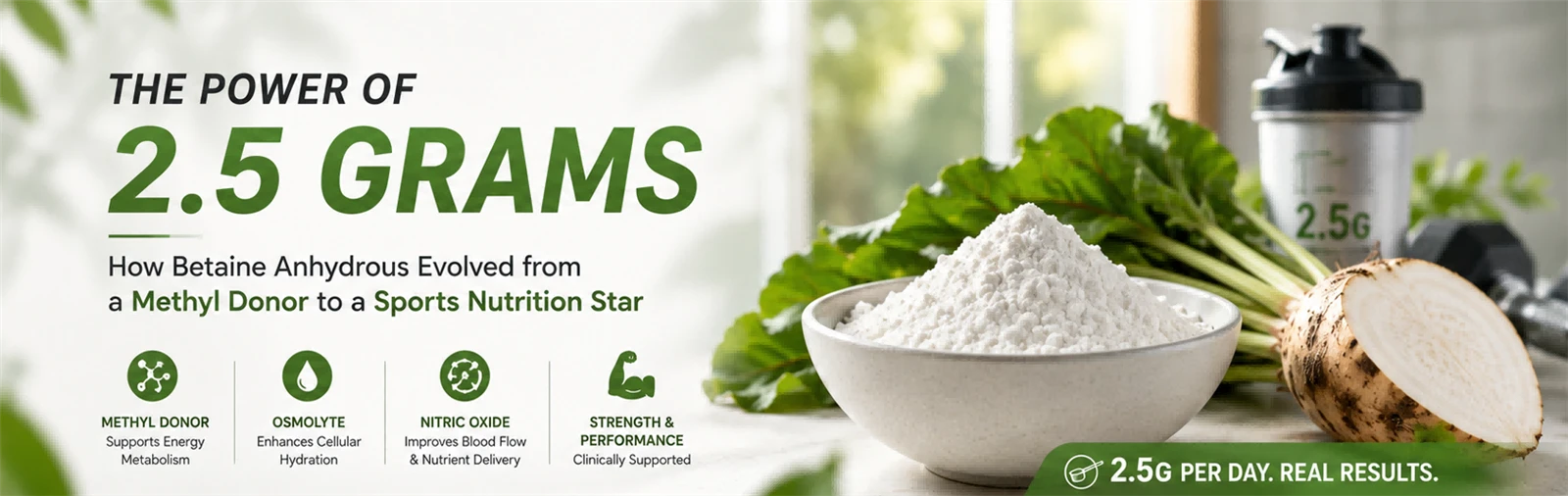
Today, betaine anhydrous has emerged as one of the most evidence-backed ingredients in sports nutrition. And the dosage that consistently appears across clinical trials? 2.5 grams per day.
This article explores how betaine anhydrous made the transition from a niche methyl donor to a mainstream performance ingredient - and why 2.5 grams has become the gold standard for formulators and athletes alike.
From Methyl Donor to Performance Enhancer - The Scientific Evolution
The Original Role: Methylation and Homocysteine Regulation
Betaine anhydrous is a naturally occurring amino acid derivative found in plants such as sugar beets, spinach, and whole grains. Its primary biological function is to act as a methyl donor - donating methyl groups to support critical biochemical processes including DNA repair, neurotransmitter synthesis, and liver detoxification.
One of betaine's most established clinical applications is the regulation of homocysteine, an amino acid linked to cardiovascular risk when present at elevated levels. By converting homocysteine to methionine, betaine anhydrous supports both cardiovascular and liver health - functions that remain relevant to this day.
The Discovery of Ergogenic Effects
The transition from metabolic health to sports performance began when researchers observed that betaine's methylation support had downstream effects relevant to exercise. Betaine promotes the biosynthesis of creatine, accelerating adenosine triphosphate (ATP) regeneration - a process particularly beneficial for short, high-intensity activities.
This discovery opened a new frontier. If betaine could support energy metabolism at the cellular level, could it also enhance strength, power, and endurance in athletes? The answer, as subsequent research would confirm, was yes.
The Triple Mechanism - Why Betaine Anhydrous Works
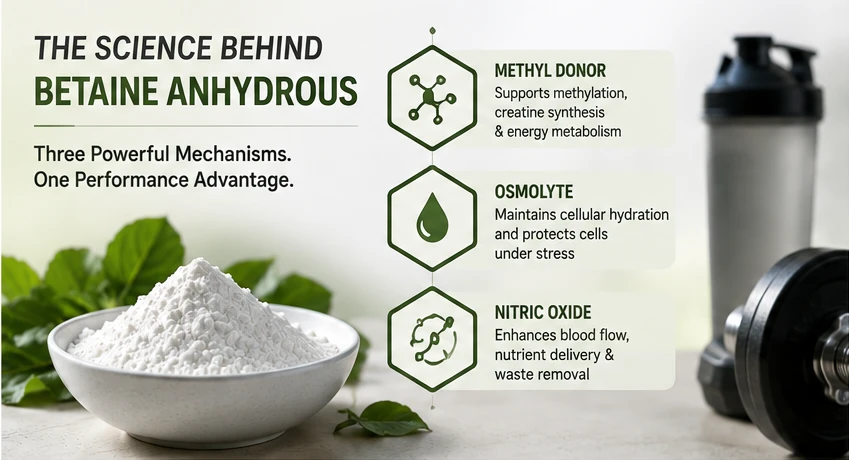
Contemporary sports nutrition science recognizes betaine anhydrous as operating through three distinct but complementary mechanisms.
Mechanism 1 - Methyl Donor for Energy Metabolism
As a methyl donor, betaine anhydrous supports the methionine cycle and the production of S-adenosylmethionine (SAMe), a compound essential for numerous metabolic reactions. This methylation support enhances creatine synthesis, which in turn accelerates ATP regeneration during high-intensity exercise.
Mechanism 2 - Osmolyte for Cellular Hydration
Betaine anhydrous functions as an organic osmolyte - a compound that helps cells maintain fluid balance and volume under stress. During intense exercise, muscle cells experience osmotic stress that can impair function. Betaine protects cells, proteins, and enzymes from this environmental stress, helping to maintain cell volume and function. This osmoprotective effect is particularly valuable for athletes training in hot or humid conditions.
Mechanism 3 - Nitric Oxide and Blood Flow
Emerging evidence suggests betaine supplementation elevates blood nitric oxide levels, potentially increasing muscle blood flow and improving nutrient delivery and waste extraction. Enhanced blood flow means better oxygen delivery to working muscles and more efficient removal of metabolic byproducts - both critical for sustained performance.
The 2.5 Gram Standard - What the Clinical Evidence Shows
Strength and Power
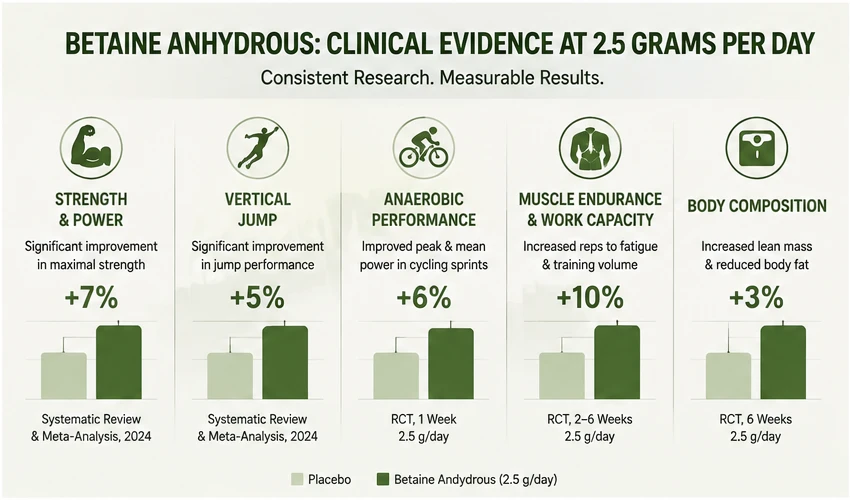
A comprehensive 2024 systematic review and meta-analysis examined 17 studies with 317 participants and found that betaine supplementation for at least seven days significantly enhances muscular strength, particularly in the lower body. The study reported a significant effect size of 0.47 for maximal strength measures, with lower body strength showing an even stronger effect (SMD: 0.49). Vertical jumping performance also improved significantly.
Muscle Endurance and Work Capacity
Randomized controlled trials have demonstrated that 2.5 grams per day of betaine anhydrous for 14 days improves squat repetitions to fatigue and enhances both upper- and lower-body muscle endurance. In strength-trained men, six weeks of daily betaine supplementation at 2.5 g/day led to improvements in body composition - increased lean mass and decreased body fat percentage - as well as increased upper body muscle size and work capacity.
CrossFit and High-Intensity Performance
A 2023 randomized crossover trial found that betaine supplementation improved CrossFit performance and increased testosterone concentrations. Notably, the study found no significant difference between 2.5 g/day and 5.0 g/day dosages, reinforcing 2.5 grams as the optimal, cost-effective dose for performance outcomes.
Anaerobic Performance
One week of betaine supplementation at 2.5 g/day significantly improved anaerobic cycling sprint performance in both males and females, with enhancements in peak and mean power comparable to those typically observed with creatine supplementation.
Why Anhydrous Matters - The Form Difference
Not all betaine is created equal. Betaine anhydrous (trimethylglycine) is the pure, non-acidic form of betaine, distinct from betaine hydrochloride (betaine HCl), which is formulated to increase stomach acid levels for digestive support.
Almost all sports nutrition randomized controlled trials use betaine anhydrous. The anhydrous form offers superior solubility and osmotic capacity compared to hydrochloride betaine, making it the preferred choice for formulators developing pre-workout powders, ready-to-mix drinks, and other sports nutrition applications.
For B2B buyers and formulators, this distinction is critical. Specifying betaine anhydrous - not betaine HCl - ensures your product delivers the performance benefits validated by clinical research.
Formulation Considerations for Sports Nutrition Products
Dosage Guidelines
The evidence-based formulation standard is 2.5 grams per day for performance applications. For hydration-focused formulations, some studies have explored higher doses up to 5 grams per day.
Application Formats
Betaine anhydrous powder integrates seamlessly into:
Pre-workout powders - supporting strength, power, and cellular hydration
Post-workout recovery blends - aiding in recovery and body composition
Ready-to-drink sports beverages - with taste-masking properties that minimize off-notes caused by vitamins and minerals
Functional foods and gummies
Quality Specifications
For B2B procurement, key specifications include:
Assay: ≥98% purity
Source: Non-GMO sugar beet extraction
Certifications: Halal, Kosher, Gluten-free, Allergen-free
Stability: Stable in water with excellent solubility
The Bottom Line for B2B Buyers
Betaine anhydrous has evolved from a metabolic health ingredient to a clinically validated sports nutrition powerhouse. The evidence is clear:
2.5 grams per day is the evidence-based standard dose
Seven to fourteen days of consistent supplementation produces measurable strength and performance improvements
Lower body strength, vertical jump performance, and muscular endurance show the most consistent benefits
Anhydrous form is the only form validated in sports nutrition research
For formulators and brand owners, betaine anhydrous represents a cost-effective, evidence-backed ingredient that delivers real performance benefits - not just marketing claims.
Ready to Formulate with Betaine Anhydrous?
At Watersol, we supply premium Betaine Anhydrous Powder with ≥98% purity, derived from Non-GMO sources, and backed by comprehensive quality documentation including COA, ISO, HACCP, and Halal/Kosher certifications.
FAQ

01.Why is 2.5 grams of betaine anhydrous considered the optimal sports nutrition dosage?
02.What is the difference between betaine anhydrous and betaine HCl?
03.Can betaine anhydrous be combined with creatine and other pre-workout ingredients?
04.Why do supplement manufacturers choose betaine anhydrous powder over other forms?
05.What quality specifications should B2B buyers check when sourcing betaine anhydrous powder?
06.What types of products can betaine anhydrous powder be used in?
References
1.Cholewa JM, Wyszczelska-Rokiel M, Glowacki R, et al.
Effects of Betaine Supplementation on Body Composition, Performance, and Hormonal Responses in Strength-Trained Men.
Journal of the International Society of Sports Nutrition. 2013;10:39.
2.Trepanowski JF, Farney TM, McCarthy CG, et al.
The Effects of Chronic Betaine Supplementation on Exercise Performance, Skeletal Muscle Oxygen Saturation and Associated Biochemical Parameters in Resistance Trained Men.
Journal of the International Society of Sports Nutrition. 2011;8:16.
3.Pryor JL, Craig SAS, Swensen T.
Effect of Betaine Supplementation on Muscular Performance and Body Composition Following Acute High-Intensity Exercise.
Journal of the International Society of Sports Nutrition. 2012;9:45.
4.Nobari H, et al.
Effects of Betaine Supplementation on Strength, Power, and Athletic Performance: A Systematic Review and Meta-Analysis.
Sports Medicine – Open. 2024.
5.Lee EC, Maresh CM, Kraemer WJ, et al.
Ergogenic Effects of Betaine Supplementation on Strength and Power Performance.
International Journal of Sport Nutrition and Exercise Metabolism. 2010.
6.Keller U, Szinnai G, Bilz S, Berneis K.
Effects of Changes in Hydration on Protein, Glucose, and Lipid Metabolism in Man: Impact of Cellular Hydration and Osmoregulation.
Nutrition Reviews. 2003;61(4):117–131.
7.Craig SAS.
Betaine in Human Nutrition.
American Journal of Clinical Nutrition. 2004;80(3):539–549.
8.Eklund M, Bauer E, Wamatu J, Mosenthin R.
Potential Nutritional and Physiological Functions of Betaine in Livestock.
Nutrition Research Reviews. 2005;18(1):31–48.