

Introduction: Moving Beyond the Search for the "Best" Rice Protein Powder
When developing a new plant-based nutrition product, many buyers begin their ingredient search with a straightforward question: "What is the best rice protein powder?" This question is understandable, especially as the demand for clean-label, dairy-free, and sustainable protein sources continues to grow across the food and nutrition industries. However, for professional formulators, the answer is rarely a single product specification or the highest protein percentage available in the market.
In commercial product development, the performance of a rice protein powder depends on how well the ingredient matches the requirements of the final application. A protein ingredient that performs well in a protein bar may not deliver the same advantages in a ready-to-drink beverage, because each product format creates different technical challenges related to texture, dispersion, flavor, stability, and processing conditions.
For this reason, experienced formulators do not simply look for the "best" rice protein powder. Instead, they evaluate which rice protein grade can provide the most suitable balance between nutritional value and functional performance. Understanding this difference allows brands to create more stable products, improve consumer experience, and avoid costly reformulation during product development.
Why There Is No Universal "Best" Rice Protein Powder?
Protein Content Is Only One Part of Ingredient Selection
One of the most common mistakes when purchasing a plant-based protein ingredient is focusing only on protein percentage. A higher protein level may appear more attractive because it supports stronger nutritional claims, but protein content alone does not determine whether an ingredient will perform successfully in a finished product.
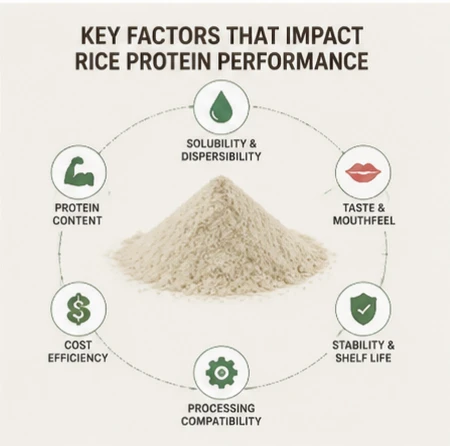
During formulation, manufacturers must consider multiple factors simultaneously, including solubility, dispersibility, taste profile, particle characteristics, processing compatibility, and overall cost efficiency. For example, a rice protein 90% grade may be suitable for a specialized high-protein supplement where maximum protein concentration is the primary goal. However, for a beverage manufacturer seeking a smooth texture and easy mixing experience, a slightly lower protein grade with improved functional performance may provide a better solution.
This is why professional buyers evaluate ingredients based on their application requirements rather than simply selecting the highest specification available. The most valuable ingredient is not necessarily the one with the highest number on the specification sheet, but the one that helps the final product achieve the desired consumer experience.
How Formulators Choose the Right Rice Protein Grade?
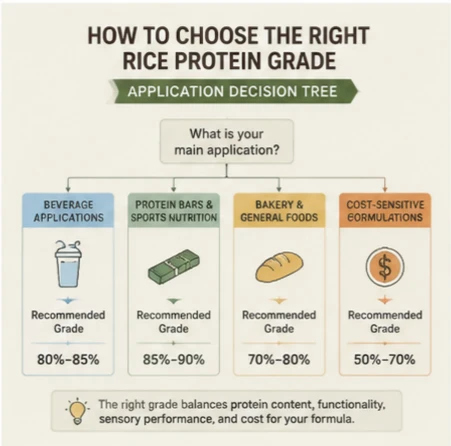
Selecting Rice Protein for Beverage Applications
The beverage sector is one of the fastest-growing areas for plant-based nutrition, but it also presents some of the most demanding challenges for protein ingredients. Unlike solid products, beverages require proteins that can disperse effectively in liquid systems while maintaining acceptable appearance, mouthfeel, and shelf stability.
Traditional plant proteins may sometimes create difficulties such as sedimentation, uneven dispersion, or a heavy texture that affects consumer acceptance. These challenges become especially important for products such as protein shakes, functional drinks, meal replacement beverages, and ready-to-mix nutrition powders.
For these applications, high solubility rice protein has become an increasingly attractive option because manufacturers need more than just high protein content. They require an ingredient that can integrate smoothly into liquid formulations and provide a pleasant sensory experience.
A balanced specification such as rice protein 80% or rice protein 85% can often provide advantages in beverage applications because it combines nutritional value with better processing flexibility. These grades allow formulators to achieve protein enrichment while maintaining smoother dispersion characteristics and the mild cereal-like flavor profile that consumers generally associate with rice-based ingredients.
When evaluating rice protein for beverages, manufacturers should consider not only the protein percentage but also how quickly the powder hydrates, whether it disperses evenly after mixing, and whether the final product maintains a consistent texture throughout its shelf life.
Selecting Rice Protein for Protein Bars and Sports Nutrition Products
Protein bars, sports nutrition snacks, and high-protein foods have different formulation priorities compared with beverages. In these applications, manufacturers often focus on achieving higher protein density while maintaining desirable texture and consumer appeal.
A higher protein concentration, such as rice protein 85% or rice protein 90%, may be considered when brands want to strengthen protein claims or reduce the amount of additional ingredients required to reach nutritional targets. However, higher protein content can also influence the physical characteristics of the final product.
For example, increasing protein concentration may affect moisture balance, firmness, and overall mouthfeel. In protein bars, formulators often need to carefully balance rice protein with other components such as fibers, sweeteners, oils, and binders to achieve the desired texture.
Therefore, selecting a protein grade is not simply a decision based on maximizing protein content. It requires understanding how the ingredient behaves within the entire formulation system.
Selecting Rice Protein for General Food and Nutrition Applications
Beyond beverages and sports nutrition, rice protein powder is also widely used in bakery products, nutritional blends, meal replacement formulas, and functional foods. In these categories, manufacturers often seek a balance between nutritional improvement, processing performance, and production cost.
For large-scale food applications, choosing a moderate protein grade can sometimes provide practical advantages because it allows manufacturers to maintain product quality while improving formulation efficiency. A balanced protein specification may contribute to better flavor integration, easier processing, and more competitive product positioning.
This is particularly important for brands developing products for mainstream consumers, where taste, affordability, and everyday usability are often more important than achieving the highest possible protein percentage.
Why Solubility Has Become a Key Factor in Modern Rice Protein Formulation?
Functional Performance Determines Consumer Experience
As the plant-based nutrition market evolves, consumers are increasingly expecting products that deliver the same convenience and sensory quality as traditional nutrition products. This shift has made rice protein solubility one of the most important evaluation factors for ingredient buyers.
A protein powder that disperses slowly or creates visible particles can negatively influence the consumer experience, even if the nutritional profile is excellent. This is particularly critical for products designed for instant preparation, where consumers expect the powder to mix quickly and create a smooth final drink.
The functional performance of a protein ingredient is influenced by multiple factors, including processing methods, particle size, protein structure, and formulation compatibility.
Therefore, buyers evaluating a rice protein powder should examine practical performance indicators rather than relying only on laboratory specifications.
A high solubility rice protein solution can help manufacturers develop products with improved mixing performance, smoother texture, and greater consumer acceptance, especially in applications where convenience is a key selling point.
Why Higher Protein Content Is Not Always Better?
Choosing Performance Over Numbers
The assumption that "higher protein means better quality" is common among consumers, but professional formulators understand that ingredient selection requires a more comprehensive approach. A successful product must balance nutritional goals with sensory quality, manufacturing efficiency, and market expectations.
For example, a beverage brand developing a clean-label plant protein drink may find that rice protein 80% or 85% provides the ideal combination of protein enrichment, smooth texture, and flavor compatibility. Meanwhile, a concentrated sports supplement may prioritize a higher protein specification because its product positioning depends more heavily on protein density.
Neither option is universally superior. The correct choice depends on the intended application, production process, and consumer expectations.
The most effective formulation strategy is not to search for the highest protein number, but to identify the ingredient grade that creates the strongest overall product performance.
A Practical Guide for Buyers Evaluating Rice Protein Powder
Before selecting a rice protein ingredient, product developers and purchasing teams should evaluate several key questions. First, they should define the final product category and understand whether the application requires beverage compatibility, high protein density, improved texture, or cost efficiency.
Next, manufacturers should assess the ingredient's functional characteristics, including dispersion speed, sensory profile, and processing behavior. These factors often determine whether the ingredient can be successfully integrated into an existing production system.
Finally, buyers should consider long-term product goals. An ingredient that performs well during initial testing but creates challenges during commercial production may increase costs and delay market launch. Selecting the appropriate rice protein grade at the beginning of development can help brands create more reliable and scalable products.
Conclusion: The Right Rice Protein Powder Is the One That Fits Your Formula
The search for the best rice protein powder should not be based on finding a single universal winner. In professional food and nutrition development, the ideal protein ingredient is determined by how effectively it supports the specific needs of the final product.
Whether developing plant-based beverages, sports nutrition products, or functional foods, manufacturers need to evaluate protein content together with solubility, sensory performance, and application compatibility.
The real question is not "Which rice protein powder is the best?" but rather "Which rice protein powder is the best choice for my formulation?"
By selecting the right rice protein grade, brands can create products that deliver better performance, stronger consumer acceptance, and more efficient production.
Soft CTA
Looking for a high solubility rice protein powder that matches your specific product requirements? Watersolu provides rice protein solutions designed for different food, beverage, and nutrition applications, helping manufacturers select the right ingredient balance between protein content and functional performance. Contact our team to discuss your formulation goals and explore a suitable rice protein solution for your next product development project.
📩 Email: info@watersolu.com
📱 WhatsApp: +86 17396654828
References
1.Day, L. (2013).
Proteins from land plants – Potential resources for human nutrition and food security.
Trends in Food Science & Technology, 32(1), 25–42.
https://doi.org/10.1016/j.tifs.2013.05.005
2.Morris, C. F., & Rose, S. P. (1996).
Wheat flour proteins: Structure, properties and functionality in food systems.
Food Chemistry, 56(2), 181–189.
3.Kumar, R., Choudhary, V., Mishra, S., Varma, I. K., & Mattiason, B. (2002).
Adhesives and plastics based on soy protein products.
Industrial Crops and Products, 16(3), 155–172.
4.Amagliani, L., O'Regan, J., Kelly, A. L., & O'Mahony, J. A. (2017).
The composition, extraction, functionality and applications of rice proteins: A review.
Trends in Food Science & Technology, 64, 1–12.
https://doi.org/10.1016/j.tifs.2017.01.008
5.Zhang, Y., Guo, S., & Wang, Z. (2016).
Rice protein: Nutritional properties, extraction technologies, and applications in food systems.
Food Research International.
6.Gorissen, S. H. M., & Witard, O. C. (2018).
Characterising the muscle anabolic potential of plant-based protein sources.
Proceedings of the Nutrition Society, 77(1), 20–31.
https://doi.org/10.1017/S0029665117001559
7.Day, L. (2016).
Proteins from land plants – Potential resources for human nutrition and food applications.
Current Opinion in Food Science, 7, 77–82.
8.Aiking, H. (2011).
Future protein supply.
Trends in Food Science & Technology, 22(1), 112–120.
https://doi.org/10.1016/j.tifs.2010.04.005
9.Loveday, S. M. (2019).
Food proteins: Technological, nutritional, and sustainability perspectives.
Annual Review of Food Science and Technology, 10, 311–336.
10.Jeske, S., Zannini, E., & Arendt, E. K. (2018).
Evaluation of physicochemical and technological properties of commercial plant-based protein powders.
Food Science & Technology, 93, 322–330.
11.Boye, J., Wijesinha-Bettoni, R., & Burlingame, B. (2012).
Protein quality evaluation twenty years after the introduction of the protein digestibility corrected amino acid score method.
British Journal of Nutrition, 108(S2), S183–S211.
https://doi.org/10.1017/S0007114512002309
12.Food and Agriculture Organization of the United Nations (FAO). (2013).
Dietary protein quality evaluation in human nutrition.
FAO Food and Nutrition Paper.